Pearson+ LogoPearson+ Logo
Ch.18 Metabolic Pathways and ATP Production
Timberlake - Chemistry: An Introduction to General, Organic, and Biological Chemistry 14th Edition
Timberlake14thChemistry: An Introduction to General, Organic, and Biological ChemistryISBN: 9781292472249Not the one you use?Change textbook
Chapter 18, Problem 47

Where is NADH oxidized in electron transport, and what is its oxidized form?

Verified step by step guidance
1
Understand the role of NADH in cellular respiration: NADH is a key electron carrier that transfers electrons to the electron transport chain (ETC) in mitochondria.
Identify the location of NADH oxidation: NADH is oxidized at Complex I (NADH dehydrogenase) in the electron transport chain, which is embedded in the inner mitochondrial membrane.
Describe the oxidation process: During oxidation, NADH donates two electrons to Complex I, which are then passed through the ETC to ultimately reduce oxygen to water.
Determine the oxidized form of NADH: When NADH is oxidized, it loses electrons and is converted into NAD⁺ (nicotinamide adenine dinucleotide).
Connect the process to energy production: The transfer of electrons from NADH to the ETC generates a proton gradient across the inner mitochondrial membrane, which drives ATP synthesis via ATP synthase.

Verified video answer for a similar problem:

This video solution was recommended by our tutors as helpful for the problem above.
Video duration:
1m
Was this helpful?

Key Concepts

Here are the essential concepts you must grasp in order to answer the question correctly.

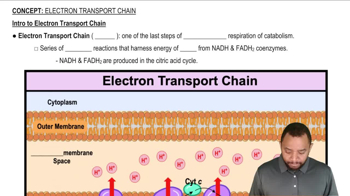
Electron Transport Chain (ETC)

The Electron Transport Chain is a series of protein complexes located in the inner mitochondrial membrane that facilitate the transfer of electrons from electron donors like NADH to electron acceptors. This process generates a proton gradient that drives ATP synthesis through oxidative phosphorylation. Understanding the ETC is crucial for identifying where NADH is oxidized.
Recommended video:
Guided course
3:10
Intro to Electron Transport Chain Concept 1

NADH Oxidation

NADH is oxidized in the Electron Transport Chain, specifically at Complex I (NADH dehydrogenase). During this process, NADH donates electrons, which are then passed through the chain, ultimately leading to the reduction of oxygen to water. This oxidation is essential for cellular respiration and energy production.
Recommended video:
Guided course
0:51
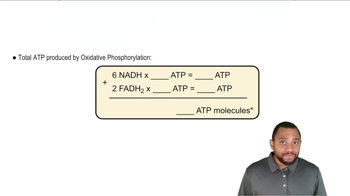
Oxidative Phosphorylation Concept 2

Oxidized Form of NADH

The oxidized form of NADH is NAD+ (Nicotinamide adenine dinucleotide). When NADH donates electrons during oxidation, it loses a hydrogen ion and becomes NAD+. This conversion is vital for maintaining the balance of redox reactions in the cell and allows NAD+ to participate in further metabolic processes.
Recommended video:
Guided course
0:51
Oxidative Phosphorylation Concept 2