Daniel suggests that Charle include one of the following mixtures in his diet. Classify each of the following as homogeneous or heterogeneous: b. tea
Ch.3 Matter and Energy
Timberlake14thChemistry: An Introduction to General, Organic, and Biological ChemistryISBN: 9781292472249Not the one you use?Change textbook
Chapter 3, Problem 8c
Indicate whether each of the following describes a gas, a liquid, or a solid:
c. Helium occupies the entire volume of a balloon.
Verified step by step guidance1
Step 1: Understand the properties of gases, liquids, and solids. Gases have no fixed shape or volume and expand to fill the container they are in. Liquids have a fixed volume but take the shape of their container. Solids have both a fixed shape and volume.
Step 2: Analyze the behavior of helium in the given scenario. The problem states that helium occupies the entire volume of a balloon.
Step 3: Relate this behavior to the properties of gases. A substance that expands to fill the entire volume of its container (in this case, the balloon) is characteristic of a gas.
Step 4: Conclude that helium in this scenario is behaving as a gas because it conforms to the property of gases by occupying the entire volume of the balloon.
Step 5: Verify your understanding by comparing this behavior to the properties of liquids and solids, which do not expand to fill the entire volume of their container.

Verified video answer for a similar problem:
This video solution was recommended by our tutors as helpful for the problem above.
Video duration:
1mWas this helpful?
Key Concepts
Here are the essential concepts you must grasp in order to answer the question correctly.
States of Matter
Matter exists in three primary states: solid, liquid, and gas. Solids have a fixed shape and volume, liquids have a fixed volume but take the shape of their container, and gases neither have a fixed shape nor a fixed volume, expanding to fill their container completely.
Recommended video:
Guided course
States of Matter Concept 1
Properties of Gases
Gases are characterized by their ability to expand and fill the volume of their container. This is due to the high kinetic energy of gas molecules, which allows them to move freely and spread out, resulting in low density and compressibility compared to solids and liquids.
Recommended video:
Guided course
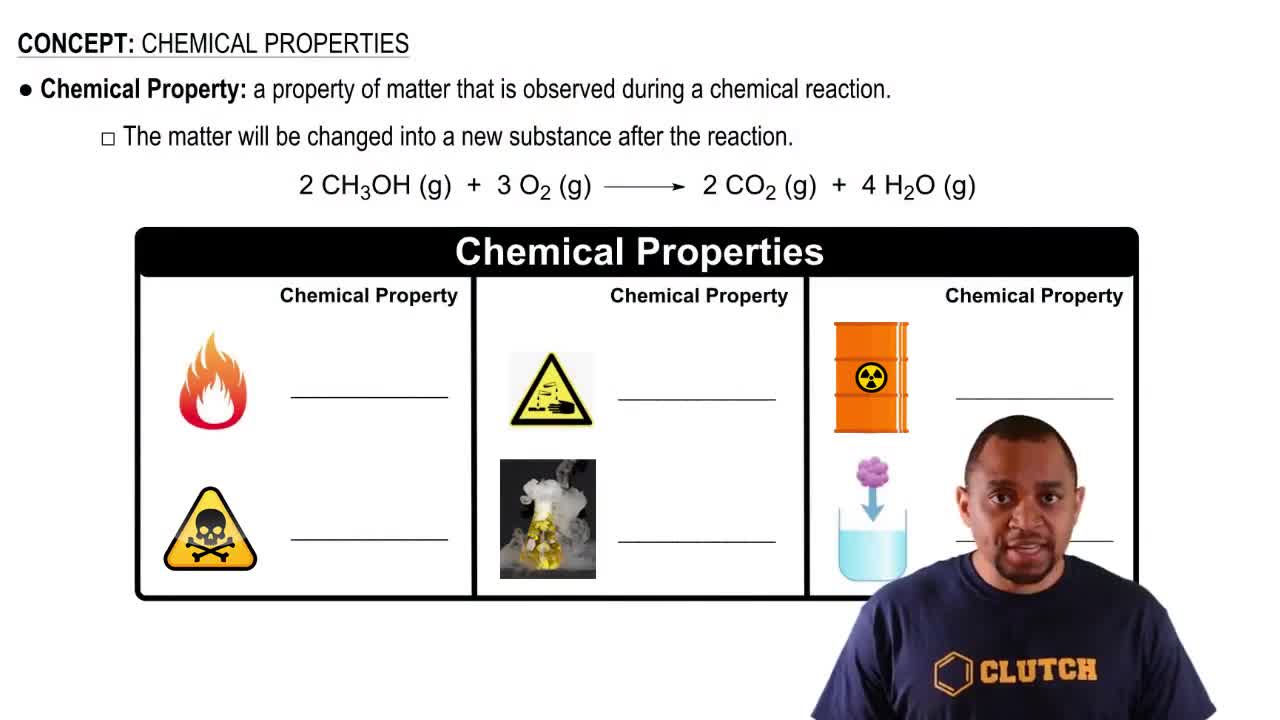
Chemical Properties Concept
Kinetic Molecular Theory
The Kinetic Molecular Theory explains the behavior of gases based on the motion of their particles. It posits that gas particles are in constant, random motion and that the temperature of a gas is directly related to the average kinetic energy of its particles, influencing how gases occupy space.
Recommended video:
Guided course
Kinetic Molecular Theory Concept 1
Related Practice
Textbook Question
34
views
Textbook Question
Indicate whether each of the following describes a gas, a liquid, or a solid:
a. Lemonade has a definite volume but takes the shape of its container
1548
views
Textbook Question
Indicate whether each of the following describes a gas, a liquid, or a solid:
b. The particles in a tank of oxygen are very far apart.
1371
views
Textbook Question
Describe each of the following as a physical or chemical property:
b. Hydrogen reacts readily with oxygen.
1586
views
Textbook Question
Describe each of the following as a physical or chemical property:
a. Chromium is a steel-gray solid.
1505
views
Textbook Question
Describe each of the following as a physical or chemical property:
b. Apple slices turn brown when they are exposed to air.
1446
views