Pearson+ LogoPearson+ Logo
Ch.4 Atoms and Elements
Timberlake - Chemistry: An Introduction to General, Organic, and Biological Chemistry 14th Edition
Timberlake14thChemistry: An Introduction to General, Organic, and Biological ChemistryISBN: 9781292472249Not the one you use?Change textbook
Chapter 4, Problem 95a

Complete the following statements:
a. The atomic number gives the number of _____ in the nucleus.

Verified step by step guidance
1
Understand the concept of atomic number: The atomic number of an element is a fundamental property that defines the element. It represents the number of protons in the nucleus of an atom.
Recall that protons are positively charged particles located in the nucleus of an atom. The atomic number is unique for each element and determines its identity.
Note that the atomic number is also equal to the number of electrons in a neutral atom, as the positive charge of protons is balanced by the negative charge of electrons.
To complete the statement, recognize that the atomic number specifically refers to the number of protons in the nucleus of an atom.
Write the completed statement: 'The atomic number gives the number of protons in the nucleus.'

Verified video answer for a similar problem:

This video solution was recommended by our tutors as helpful for the problem above.
Video duration:
1m
Was this helpful?

Key Concepts

Here are the essential concepts you must grasp in order to answer the question correctly.

Atomic Number

The atomic number is a fundamental property of an element that indicates the number of protons present in the nucleus of an atom. It uniquely identifies an element and determines its position in the periodic table. For example, hydrogen has an atomic number of 1, meaning it has one proton.
Recommended video:
Guided course
02:42
Calculate Oxidation Numbers

Protons

Protons are positively charged subatomic particles found in the nucleus of an atom. They play a crucial role in defining the identity of an element, as the number of protons determines the element's atomic number. For instance, an atom with two protons is helium, while one with six is carbon.
Recommended video:

Nucleus

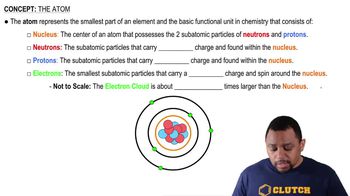
The nucleus is the central core of an atom, containing protons and neutrons. It is responsible for most of the atom's mass and is held together by strong nuclear forces. The arrangement and number of particles in the nucleus influence the atom's stability and its chemical behavior.
Recommended video:
Guided course
01:44
The Atom (Simplified) Concept 1