Pearson+ LogoPearson+ Logo
Ch.4 Atoms and Elements
Timberlake - Chemistry: An Introduction to General, Organic, and Biological Chemistry 14th Edition
Timberlake14thChemistry: An Introduction to General, Organic, and Biological ChemistryISBN: 9781292472249Not the one you use?Change textbook
Chapter 4, Problem 96b

Complete the following statements:
b. The elements in Group 7A (17) are called the _____.

Verified step by step guidance
1
Understand the periodic table's group numbering system: Group 7A (or Group 17 in the modern IUPAC system) refers to the column of elements located second to last on the right side of the periodic table.
Recall that elements in Group 7A (17) are known for having seven valence electrons, which makes them highly reactive and prone to forming compounds by gaining one electron to complete their octet.
Learn the name of this group: The elements in Group 7A (17) are collectively called the 'halogens.' The term 'halogen' comes from Greek words meaning 'salt-former,' as these elements commonly form salts when they react with metals.
Identify the specific elements in this group: The halogens include fluorine (F), chlorine (Cl), bromine (Br), iodine (I), and astatine (At). These elements share similar chemical properties due to their electron configuration.
Understand the significance of halogens in chemistry: Halogens are widely used in various applications, such as disinfectants (chlorine), lighting (fluorine in fluorescent bulbs), and pharmaceuticals (iodine). Their reactivity makes them important in many chemical reactions.

Verified video answer for a similar problem:

This video solution was recommended by our tutors as helpful for the problem above.
Video duration:
1m
Was this helpful?

Key Concepts

Here are the essential concepts you must grasp in order to answer the question correctly.

Group 7A Elements

Group 7A, also known as Group 17 in the periodic table, consists of the halogens. These elements include fluorine, chlorine, bromine, iodine, and astatine. They are characterized by their high reactivity, particularly with alkali and alkaline earth metals, forming salts. Understanding their properties and reactivity is essential for completing the statement.
Recommended video:
Guided course
07:38
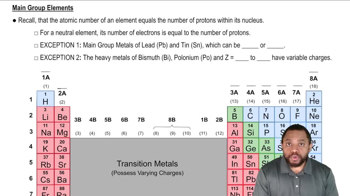
Periodic Table: Main Group Element Charges Concept 2

Halogens

Halogens are a group of non-metal elements that are found in Group 7A (17) of the periodic table. They are known for their distinct colors and strong odors, as well as their ability to form diatomic molecules (e.g., F2, Cl2). Halogens play significant roles in various chemical reactions and are commonly used in disinfectants and pharmaceuticals.
Recommended video:
Guided course
1:11
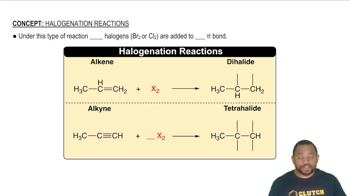
Halogenation Reactions Concept 1

Periodic Table Groups

The periodic table is organized into columns called groups, which categorize elements with similar chemical properties. Group 7A (17) is one of these groups, and elements within a group share similar valence electron configurations, influencing their reactivity and bonding behavior. Recognizing the significance of groups helps in understanding elemental relationships and predicting chemical behavior.
Recommended video:
Guided course
05:33
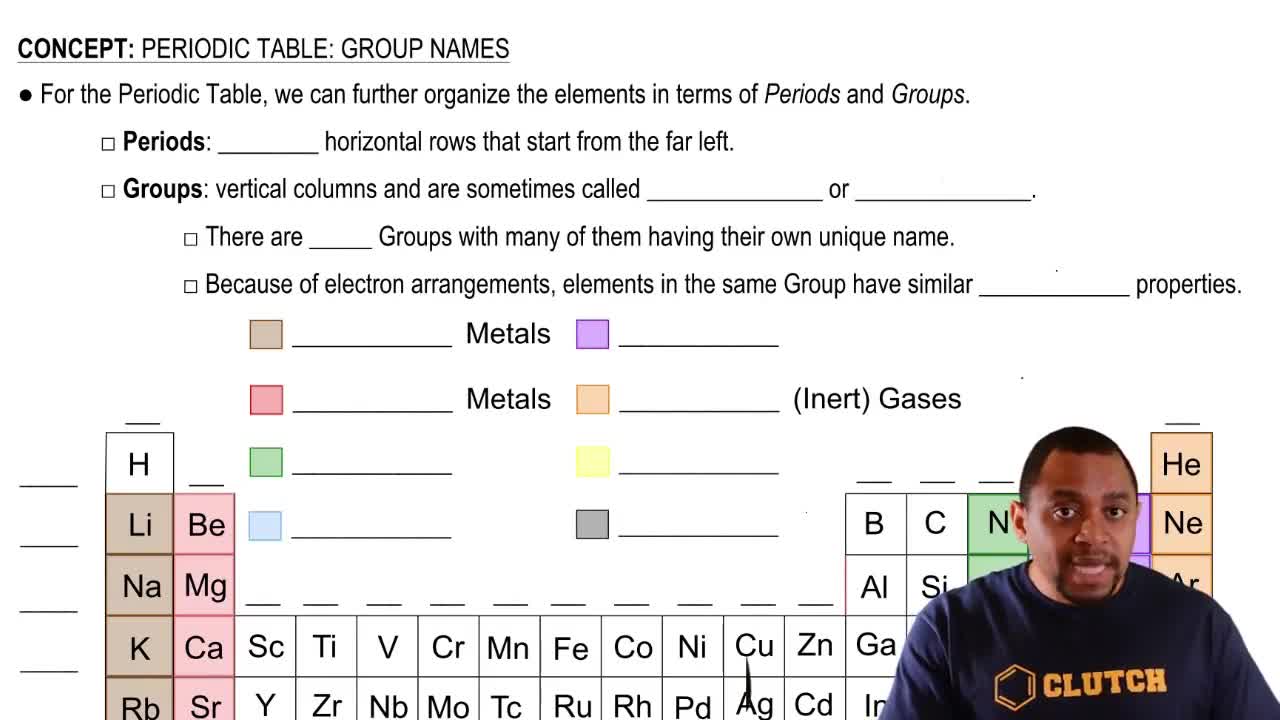
Periodic Table: Group Names