Where does fusion occur naturally?
Ch.5 Nuclear Chemistry
Timberlake14thChemistry: An Introduction to General, Organic, and Biological ChemistryISBN: 9781292472249Not the one you use?Change textbook
Chapter 5, Problem 66a
Write the balanced nuclear equation for each of the following: (5.2) a. Actinium-225 decays to give francium-221.
Verified step by step guidance1
Identify the type of decay occurring. Actinium-225 decays to francium-221, which suggests the emission of a particle. Determine the type of particle emitted based on the change in mass number and atomic number.
Write the initial isotope: Actinium-225. Its symbol is , where 225 is the mass number and 89 is the atomic number.
Write the resulting isotope: Francium-221. Its symbol is , where 221 is the mass number and 87 is the atomic number.
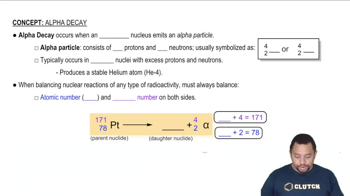
Determine the particle emitted during the decay. The mass number decreases by 4 (225 - 221), and the atomic number decreases by 2 (89 - 87). This indicates the emission of an alpha particle, represented as .
Write the balanced nuclear equation: Combine the initial isotope, the resulting isotope, and the emitted alpha particle to form the equation:

Verified video answer for a similar problem:
This video solution was recommended by our tutors as helpful for the problem above.
Video duration:
2mWas this helpful?
Key Concepts
Here are the essential concepts you must grasp in order to answer the question correctly.
Nuclear Decay
Nuclear decay is a process by which an unstable atomic nucleus loses energy by emitting radiation. This can occur in various forms, including alpha decay, beta decay, and gamma decay. In the context of the question, Actinium-225 undergoes decay to transform into a more stable nucleus, which is essential for understanding the resulting products of the reaction.
Recommended video:
Guided course
Alpha Decay
Balanced Nuclear Equation
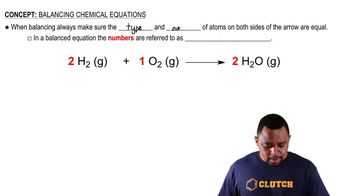
A balanced nuclear equation represents the transformation of one element into another during a nuclear reaction, ensuring that the number of protons and neutrons is conserved. This equation includes the atomic numbers and mass numbers of the reactants and products, allowing for a clear depiction of the decay process. Balancing these equations is crucial for accurately describing nuclear reactions.
Recommended video:
Guided course
Balancing Chemical Equations (Simplified) Concept 1
Isotopes
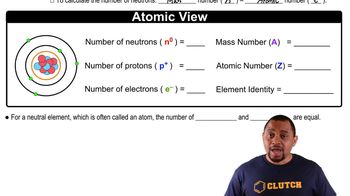
Isotopes are variants of a particular chemical element that have the same number of protons but different numbers of neutrons, resulting in different mass numbers. In this case, Actinium-225 and Francium-221 are isotopes of their respective elements, and understanding their isotopic nature is vital for writing the correct balanced nuclear equation during the decay process.
Recommended video:
Guided course
Isotopes
Related Practice
Textbook Question
1035
views
Textbook Question
Write the balanced nuclear equation for each of the following:
e. In-113m (γ emission)
793
views
Textbook Question
Complete each of the following nuclear equations:
d. 23m12Mg → ? + 00γ
832
views
Textbook Question
Write the balanced nuclear equation for each of the following:
a. When two oxygen-16 atoms collide, one of the products is an alpha particle.
758
views
Textbook Question
What are the products in the fission of uranium-235 that make possible a nuclear chain reaction?
1176
views
Textbook Question
All the elements beyond uranium, the transuranium elements, have been prepared by bombardment and are not naturally occurring elements. The first transuranium element neptunium, Np, was prepared by bombarding U-238 with neutrons to form a neptunium atom and a beta particle. Complete the following equation:
10n + 23892U →? + ?
1016
views