

Pearson+ LogoPearson+ Logo
Ch.8 Gases
Timberlake - Chemistry: An Introduction to General, Organic, and Biological Chemistry 14th Edition
Timberlake14thChemistry: An Introduction to General, Organic, and Biological ChemistryISBN: 9781292472249Not the one you use?Change textbook
Chapter 8, Problem 28b

A solution containing 80. g of NaNO3 in 75 g of H2O at 50 °C is cooled to 20 °C. b. How many grams of solid NaNO3 crystallized after cooling?

Verified step by step guidance
1
Step 1: Understand the solubility concept. Solubility is the maximum amount of solute that can dissolve in a given amount of solvent at a specific temperature. For NaNO₃, the solubility changes with temperature, and this information is typically provided in a solubility chart or table.
Step 2: Refer to the solubility chart for NaNO₃. Find the solubility of NaNO₃ at 50 °C and at 20 °C. For example, if the solubility at 50 °C is X g per 100 g of H₂O and at 20 °C is Y g per 100 g of H₂O, use these values for calculations.
Step 3: Calculate the amount of NaNO₃ that can dissolve in 75 g of H₂O at 50 °C. Use the proportion: \( \text{Amount of NaNO₃ dissolved} = \frac{X}{100} \times 75 \).
Step 4: Calculate the amount of NaNO₃ that can dissolve in 75 g of H₂O at 20 °C. Use the proportion: \( \text{Amount of NaNO₃ dissolved} = \frac{Y}{100} \times 75 \).
Step 5: Subtract the amount of NaNO₃ that can dissolve at 20 °C from the amount that was dissolved at 50 °C. The difference represents the mass of NaNO₃ that crystallized: \( \text{Mass crystallized} = \text{Amount dissolved at 50 °C} - \text{Amount dissolved at 20 °C} \).

Verified video answer for a similar problem:

This video solution was recommended by our tutors as helpful for the problem above.
Video duration:
6m
Was this helpful?

Key Concepts

Here are the essential concepts you must grasp in order to answer the question correctly.

Solubility

Solubility refers to the maximum amount of a solute that can dissolve in a solvent at a given temperature. In this case, the solubility of NaNO3 in water changes with temperature, meaning that as the solution cools from 50 °C to 20 °C, the amount of NaNO3 that can remain dissolved decreases, leading to crystallization.
Recommended video:
Guided course
00:28
Solubility Rules

Crystallization

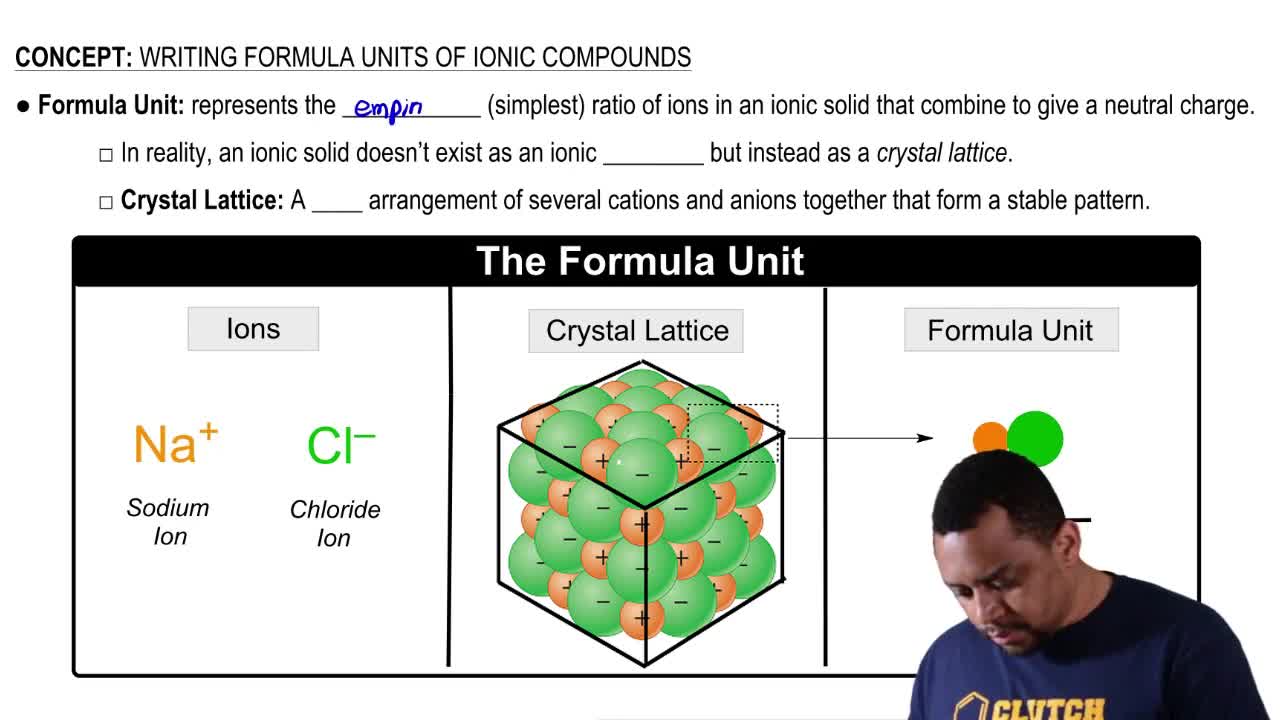
Crystallization is the process where dissolved solute comes out of solution and forms solid crystals. This occurs when the solution becomes supersaturated, which can happen when the temperature drops, causing excess solute to precipitate out of the solution as solid NaNO3.
Recommended video:
Guided course
01:46
Writing Formula Units of Ionic Compounds Concept 1

Mass Balance

Mass balance is a principle used to account for the mass of substances in a system. In this scenario, it involves calculating the initial mass of NaNO3, determining how much remains dissolved at the lower temperature, and finding the difference to ascertain the mass of NaNO3 that crystallized out of the solution.
Recommended video:
Guided course
00:38
Mass Percent Concept