Balance each of the following neutralization equations:a. HCl(aq) + Mg(OH)₂(s) → H₂O(l) + MgCl(aq)
Verified step by step guidance
1
Identify the reactants and products in the equation: HCl(aq) and Mg(OH)_2(s) are the reactants, while H_2O(l) and MgCl(aq) are the products.
Write the unbalanced chemical equation: HCl(aq) + Mg(OH)_2(s) → H_2O(l) + MgCl(aq).
Balance the magnesium (Mg) atoms: There is 1 Mg atom on both sides, so they are already balanced.
Balance the chlorine (Cl) atoms: There is 1 Cl atom in MgCl on the product side, so you need 2 HCl molecules on the reactant side to balance the Cl atoms.
Balance the hydrogen (H) and oxygen (O) atoms: With 2 HCl, you have 2 H atoms from HCl and 2 H atoms from Mg(OH)_2, making 4 H atoms total. This requires 2 H_2O molecules on the product side to balance the H atoms. The O atoms are balanced with 2 H_2O molecules.
Verified video answer for a similar problem:
This video solution was recommended by our tutors as helpful for the problem above
Video duration:
4m
Play a video:
0 Comments
Key Concepts
Here are the essential concepts you must grasp in order to answer the question correctly.
Neutralization Reaction
A neutralization reaction occurs when an acid reacts with a base to produce water and a salt. In this process, the hydrogen ions (H⁺) from the acid combine with hydroxide ions (OH⁻) from the base to form water (H₂O). The remaining ions form the salt, which is typically soluble in water. Understanding this concept is crucial for balancing the chemical equation correctly.
Lewis Dot Structures: Neutral Compounds (Simplified) Concept 1
Balancing Chemical Equations
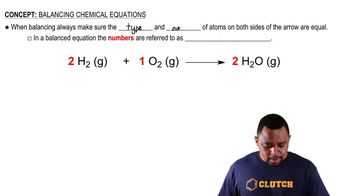
Balancing chemical equations involves ensuring that the number of atoms of each element is the same on both sides of the equation. This is achieved by adjusting the coefficients in front of the chemical formulas. The law of conservation of mass dictates that matter cannot be created or destroyed in a chemical reaction, making balancing essential for accurate representation of the reaction.
Balancing Chemical Equations (Simplified) Concept 1
State Symbols in Chemical Equations
State symbols indicate the physical state of the reactants and products in a chemical reaction. Common symbols include (aq) for aqueous solutions, (s) for solids, (l) for liquids, and (g) for gases. Recognizing these symbols helps in understanding the conditions under which the reaction occurs and is important for correctly interpreting and balancing the equation.

 4:11 minutes
 Verified step by step guidance
 00:37
00:37