Select the more polar bond in each of the following pairs: (6.7)c. Br―Cl or S―Cl
Verified step by step guidance
1
Identify the concept of electronegativity: Electronegativity is the ability of an atom to attract electrons in a chemical bond. The greater the difference in electronegativity between two atoms, the more polar the bond.
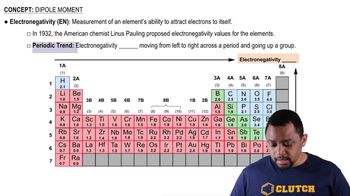
Find the electronegativity values: Look up the electronegativity values for bromine (Br), chlorine (Cl), and sulfur (S).
Calculate the electronegativity difference for each bond: Subtract the electronegativity of one atom from the other in each bond pair.
Compare the differences: The bond with the larger electronegativity difference is the more polar bond.
Select the more polar bond: Based on the calculated differences, determine which bond is more polar.
Verified video answer for a similar problem:
This video solution was recommended by our tutors as helpful for the problem above
Video duration:
2m
Play a video:
0 Comments
Key Concepts
Here are the essential concepts you must grasp in order to answer the question correctly.
Electronegativity
Electronegativity is a measure of an atom's ability to attract and hold onto electrons in a chemical bond. The greater the difference in electronegativity between two bonded atoms, the more polar the bond will be. In this context, understanding the electronegativity values of bromine, chlorine, and sulfur is essential to determine which bond is more polar.
Bond polarity refers to the distribution of electrical charge across a bond between two atoms. A polar bond occurs when there is an unequal sharing of electrons due to differences in electronegativity. This results in a dipole moment, where one end of the bond is slightly negative and the other slightly positive, influencing the bond's overall polarity.
To determine which bond is more polar, a comparative analysis of the bonds in question is necessary. This involves evaluating the electronegativity differences between the atoms in each bond pair. By calculating or referencing the electronegativity values, one can ascertain which bond exhibits a greater degree of polarity based on the relative differences.

 2:42 minutes
 Verified step by step guidance
 01:51
01:51