Many compounds are only partially dissociated into ions in aqueous solution. Trichloroacetic acid (CCl₃CO₂H), for instance, is partially dissociated in water according to the equationCCl₃CO₂H (aq) → H⁺ (aq) + CCl₃CO₂⁻ (aq)For a solution prepared by dissolving 1.00 mol of trichloroacetic acid in 1.00 kg of water, 36.0% of the trichloroacetic acid dissociates to form H⁺ and CCl₃CO₂⁻ ions.What is the freezing point of this solution? (The freezing point of 1 kg of water is lowered 1.86 °C for each mole of solute particles.)
Verified step by step guidance
1
Identify the initial amount of trichloroacetic acid: 1.00 mol.
Calculate the amount of trichloroacetic acid that dissociates: 36.0% of 1.00 mol.
Determine the moles of ions produced: Each mole of dissociated trichloroacetic acid produces 1 mole of H⁺ and 1 mole of CCl₃CO₂⁻.
Calculate the total moles of solute particles in the solution: sum of undissociated trichloroacetic acid and the ions produced.
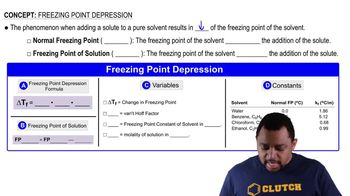
Use the freezing point depression formula: ΔT_f = i \, K_f \, m, where i is the van't Hoff factor (number of particles the solute dissociates into), K_f is the freezing point depression constant (1.86 °C kg/mol for water), and m is the molality of the solution.
Verified video answer for a similar problem:
This video solution was recommended by our tutors as helpful for the problem above
Video duration:
3m
Play a video:
0 Comments
Key Concepts
Here are the essential concepts you must grasp in order to answer the question correctly.
Dissociation of Acids
Dissociation refers to the process by which an acid separates into its constituent ions in solution. In the case of trichloroacetic acid, it partially dissociates into hydrogen ions (H⁺) and trichloroacetate ions (CCl₃CO₂⁻). Understanding the extent of dissociation is crucial for calculating the concentration of ions in solution, which directly affects properties like freezing point.
Colligative properties are physical properties of solutions that depend on the number of solute particles rather than their identity. Freezing point depression is one such property, where the presence of solute particles lowers the freezing point of a solvent. The formula for freezing point depression states that the change in freezing point is proportional to the molality of the solute particles in the solution.
Molality is a measure of the concentration of a solute in a solution, defined as the number of moles of solute per kilogram of solvent. In this scenario, the freezing point of the solution can be calculated using the formula ΔTf = i * Kf * m, where 'i' is the van 't Hoff factor (number of particles the solute dissociates into), 'Kf' is the freezing point depression constant, and 'm' is the molality of the solution. For trichloroacetic acid, the calculation involves determining the effective number of particles based on the degree of dissociation.