Which sample contains more molecules: 2.0 L of Cl₂ at STP or 3.0 L of CH₄ at 300 K and 1150 mmHg? Which sample weighs more?
Verified step by step guidance
1
Identify the conditions for each gas sample: Cl₂ is at STP (Standard Temperature and Pressure), which is 0°C (273.15 K) and 1 atm (760 mmHg), while CH₄ is at 300 K and 1150 mmHg.
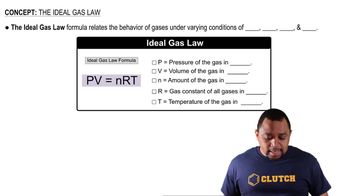
Use the ideal gas law, PV = nRT, to calculate the number of moles (n) for each gas. For Cl₂ at STP, use P = 1 atm, V = 2.0 L, R = 0.0821 L·atm/mol·K, and T = 273.15 K. For CH₄, convert 1150 mmHg to atm and use P = 1150 mmHg / 760 mmHg/atm, V = 3.0 L, R = 0.0821 L·atm/mol·K, and T = 300 K.
Calculate the number of molecules for each sample using Avogadro's number (6.022 × 10²³ molecules/mol) by multiplying the moles obtained from the ideal gas law by Avogadro's number.
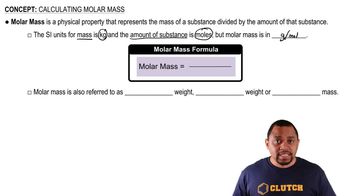
Determine the molar mass of each gas: Cl₂ has a molar mass of approximately 70.9 g/mol (35.45 g/mol per Cl atom), and CH₄ has a molar mass of approximately 16.0 g/mol (12.01 g/mol for C and 1.008 g/mol for each H).
Calculate the mass of each sample by multiplying the number of moles by the molar mass of the respective gas. Compare the masses to determine which sample weighs more.
Verified video answer for a similar problem:
This video solution was recommended by our tutors as helpful for the problem above
Video duration:
3m
Play a video:
0 Comments
Key Concepts
Here are the essential concepts you must grasp in order to answer the question correctly.
Avogadro's Law
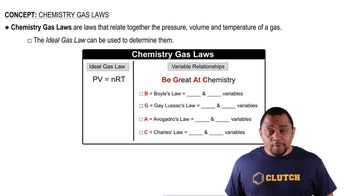
Avogadro's Law states that equal volumes of gases, at the same temperature and pressure, contain an equal number of molecules. This principle allows us to compare the number of molecules in different gas samples by considering their volumes under standard conditions, such as STP (Standard Temperature and Pressure).
The Ideal Gas Law (PV = nRT) relates the pressure (P), volume (V), temperature (T), and number of moles (n) of a gas, with R being the ideal gas constant. This law is essential for calculating the number of moles of gas in non-standard conditions, such as the 3.0 L of CH₄ at 300 K and 1150 mmHg, allowing for a comparison of the number of molecules in both samples.
Molar mass is the mass of one mole of a substance, typically expressed in grams per mole (g/mol). To determine which gas sample weighs more, we can calculate the mass of each gas using its molar mass and the number of moles derived from the Ideal Gas Law. This comparison will reveal which sample has a greater mass.