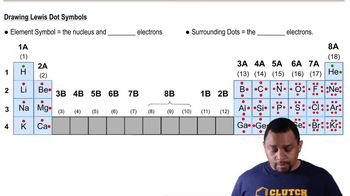
Consider an ion with the symbol Y³⁻ formed from a representative element. (6.1, 6.2, 6.3)b. What is the Lewis symbol of the element?
Verified step by step guidance
1
Identify the representative element that forms the Y³⁻ ion. This means the element has gained 3 electrons to achieve a stable electron configuration.
Determine the group number of the element in the periodic table. Elements that form anions by gaining electrons are typically nonmetals found in groups 15, 16, or 17.
Calculate the number of valence electrons in the neutral atom of the element. This is equal to the group number for main group elements.
Draw the Lewis symbol for the neutral atom by placing dots around the element's symbol to represent its valence electrons.
Adjust the Lewis symbol to reflect the formation of the Y³⁻ ion by adding three additional dots to represent the gained electrons, resulting in a total of 8 dots, indicating a full octet.
Verified video answer for a similar problem:
This video solution was recommended by our tutors as helpful for the problem above
Video duration:
2m
Play a video:
0 Comments
Key Concepts
Here are the essential concepts you must grasp in order to answer the question correctly.
Ionic Charge and Formation
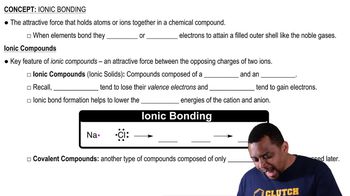
Ionic charge refers to the electrical charge an atom acquires when it gains or loses electrons. In this case, Y³⁻ indicates that the element has gained three electrons, resulting in a negative charge. Understanding how elements form ions is crucial for predicting their behavior in chemical reactions and their placement in the periodic table.
Lewis symbols, or Lewis dot structures, represent the valence electrons of an atom as dots around the element's symbol. This visual representation helps in understanding how atoms bond with each other. For an element that forms a Y³⁻ ion, the Lewis symbol will show the element's symbol surrounded by six dots, indicating the three additional electrons gained.
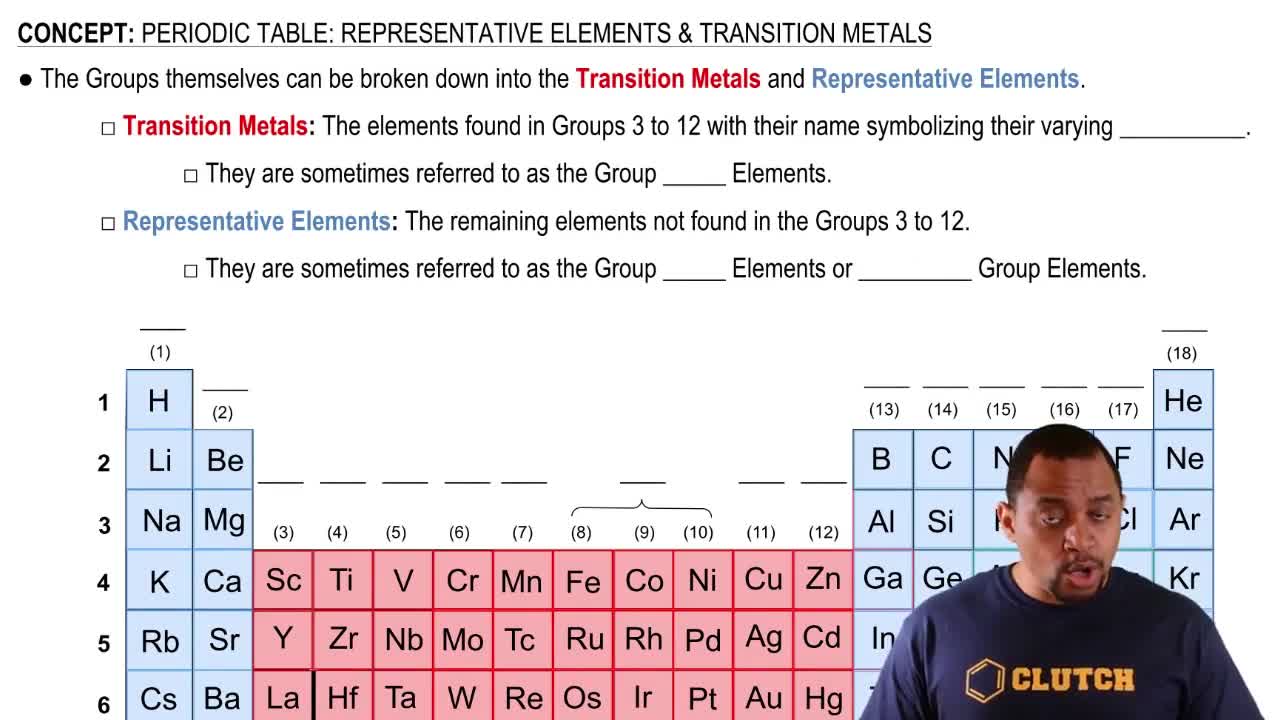
Representative elements are found in groups 1, 2, and 13-18 of the periodic table and include metals, nonmetals, and metalloids. These elements typically exhibit predictable behavior in terms of electron configuration and bonding. Recognizing that Y is a representative element helps in determining its Lewis symbol and understanding its ionic characteristics.

 2:52 minutes
 Verified step by step guidance
 02:33
02:33