An element has completely filled n = 1 and n = 2 shells and has six electrons in the n = 3 shell. Identify the element and its major group (i.e., main group, transition, etc.). Is it a metal or a nonmetal? Identify the orbital in which the last electron is found.
Verified step by step guidance
1
Step 1: Determine the total number of electrons in the element. The n = 1 shell can hold 2 electrons, and the n = 2 shell can hold 8 electrons. The n = 3 shell has 6 electrons. Add these together to find the total number of electrons: 2 + 8 + 6.
Step 2: Use the total number of electrons to identify the element on the periodic table. The atomic number of the element is equal to the total number of electrons.
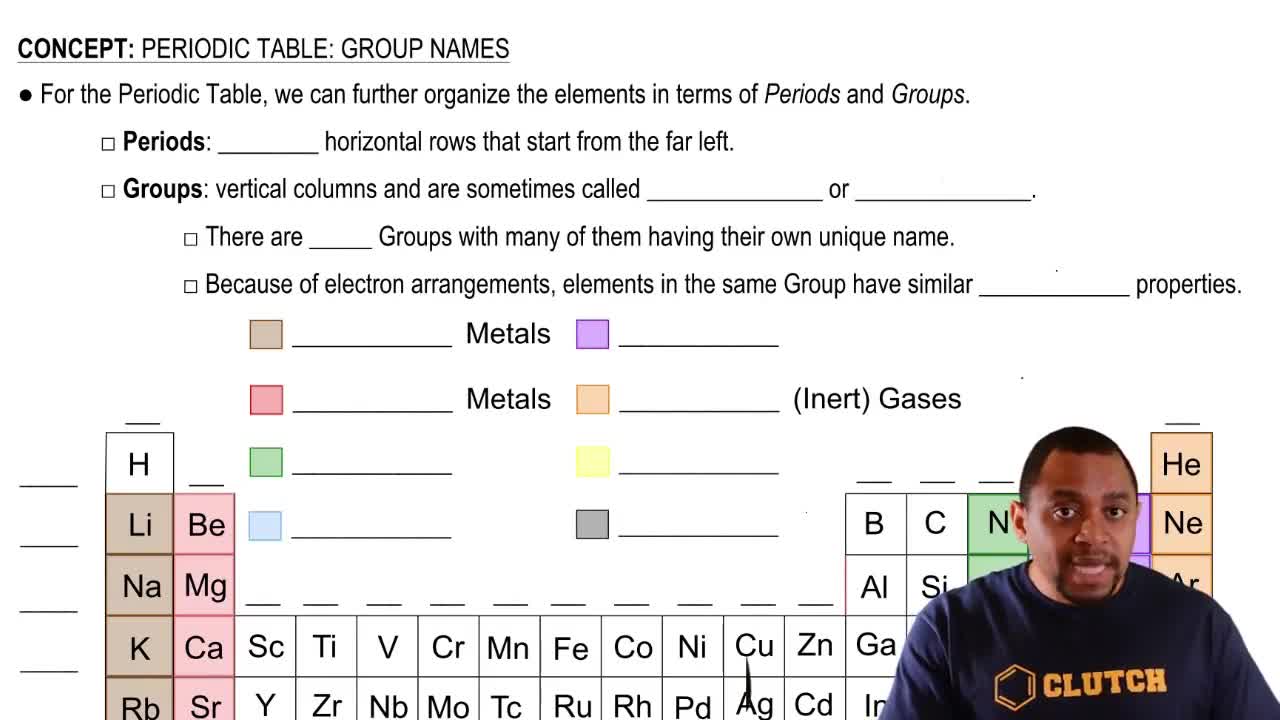
Step 3: Determine the major group of the element. Check the periodic table to see if the element is in the main group, transition metals, or another category.
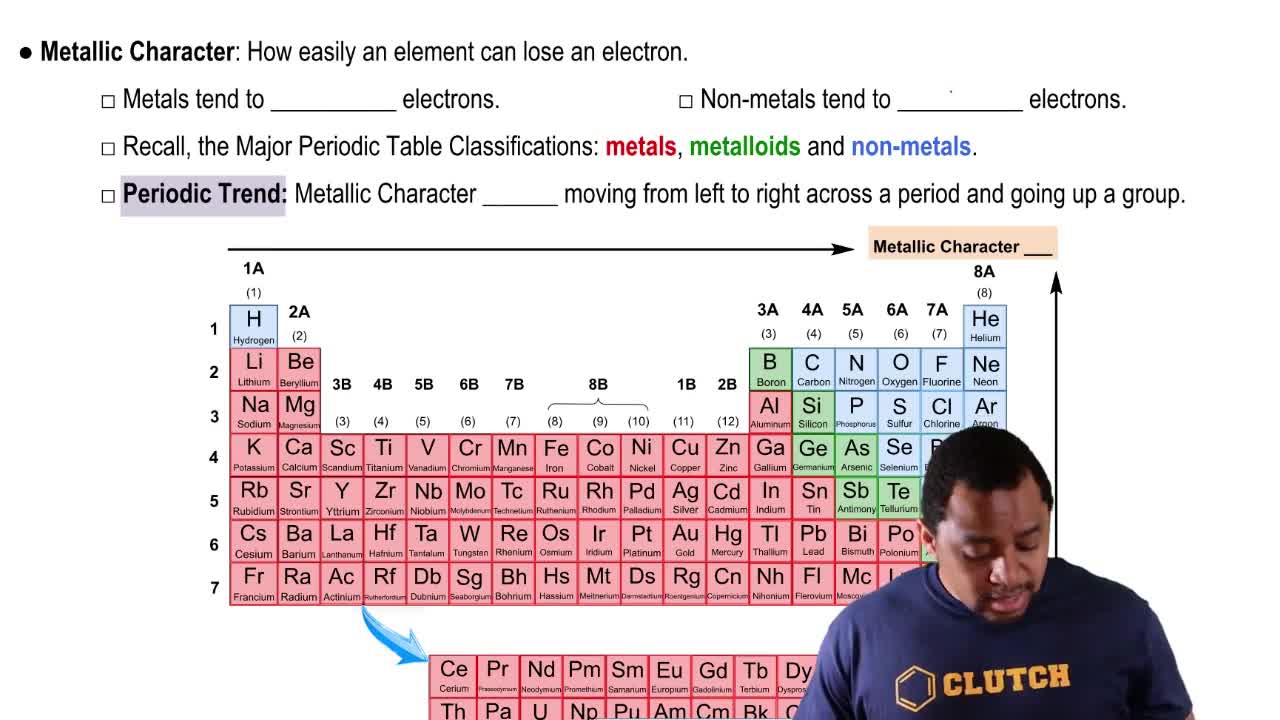
Step 4: Identify if the element is a metal or a nonmetal. This can be determined by its position on the periodic table and its properties.
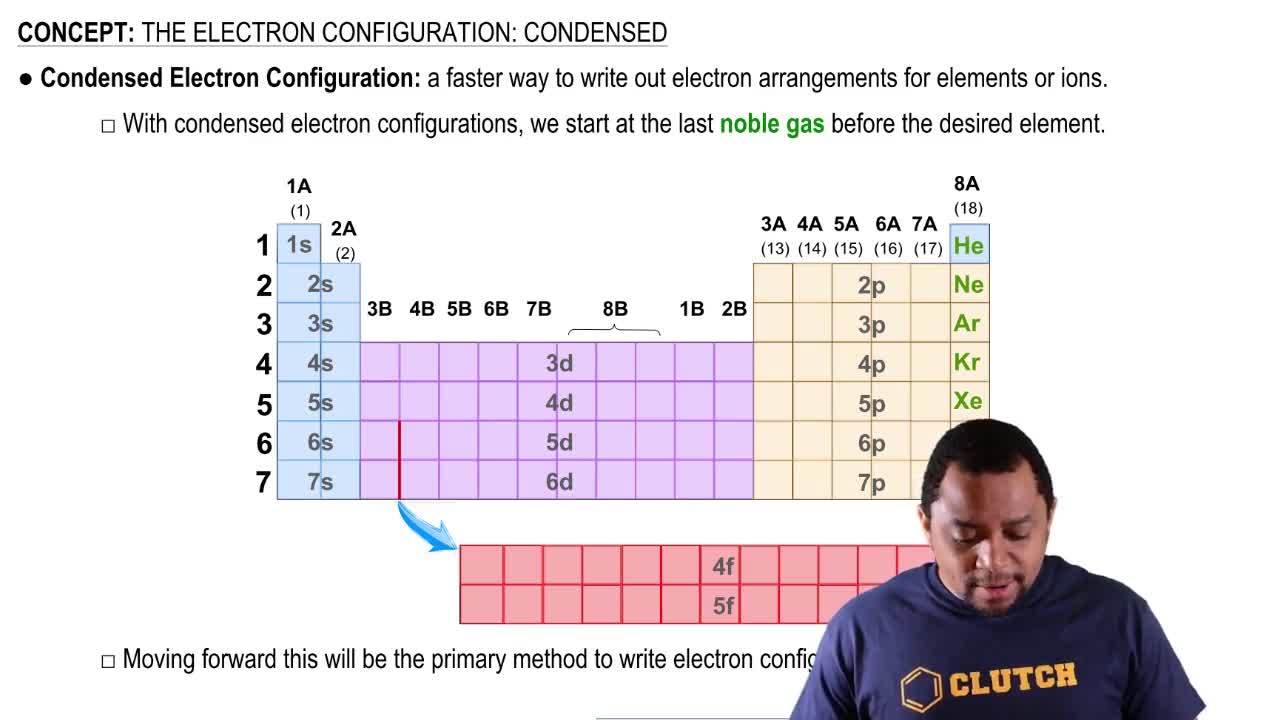
Step 5: Identify the orbital in which the last electron is found. Since the n = 3 shell is being filled, consider the subshells (s, p, d) and determine where the last electron is located based on the electron configuration.
Verified video answer for a similar problem:
This video solution was recommended by our tutors as helpful for the problem above
Video duration:
1m
Play a video:
0 Comments
Key Concepts
Here are the essential concepts you must grasp in order to answer the question correctly.
Electron Configuration
Electron configuration describes the distribution of electrons in an atom's orbitals. For the given element, the filled n = 1 and n = 2 shells indicate that these orbitals are fully occupied, while the presence of six electrons in the n = 3 shell suggests a configuration of 3s² 3p⁴, which corresponds to the element sulfur.
Elements are organized into groups on the periodic table based on their electron configurations and chemical properties. The element with six electrons in the n = 3 shell belongs to Group 16 (the chalcogens), which is classified as a main group element. This classification helps in predicting the element's reactivity and bonding behavior.
Metals and nonmetals are distinguished by their physical and chemical properties. Nonmetals, such as sulfur, typically have higher electronegativities and are poor conductors of heat and electricity. In this case, sulfur is a nonmetal, and the last electron is found in the 3p orbital, indicating its position in the p-block of the periodic table.

 1:55 minutes
 Verified step by step guidance
 01:08
01:08