KF is a strong electrolyte, and HF is a weak electrolyte. How is the solution of KF different from that of HF?
Verified step by step guidance
1
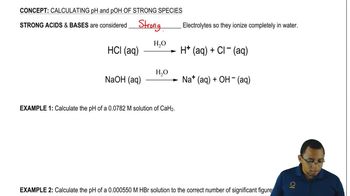
Identify the nature of the electrolytes: KF is a strong electrolyte, meaning it completely dissociates into ions in solution. HF is a weak electrolyte, meaning it only partially dissociates into ions.
Write the dissociation equation for KF: \( \text{KF} \rightarrow \text{K}^+ + \text{F}^- \). This indicates that in solution, KF will fully dissociate into potassium ions (K^+) and fluoride ions (F^-).
Write the dissociation equation for HF: \( \text{HF} \rightleftharpoons \text{H}^+ + \text{F}^- \). This indicates that in solution, HF will only partially dissociate, establishing an equilibrium between the undissociated HF molecules and the ions.
Compare the ion concentration: In a solution of KF, the concentration of ions (K^+ and F^-) will be equal to the initial concentration of KF, as it fully dissociates. In contrast, the concentration of ions in an HF solution will be less than the initial concentration of HF due to its partial dissociation.
Discuss the electrical conductivity: A solution of KF will have higher electrical conductivity compared to a solution of HF because the complete dissociation of KF results in more free ions to carry the electric current.
Verified video answer for a similar problem:
This video solution was recommended by our tutors as helpful for the problem above
Video duration:
5m
Play a video:
0 Comments
Key Concepts
Here are the essential concepts you must grasp in order to answer the question correctly.
Electrolytes
Electrolytes are substances that dissociate into ions when dissolved in water, allowing the solution to conduct electricity. They are classified into strong electrolytes, which completely dissociate into ions, and weak electrolytes, which only partially dissociate. Understanding the behavior of electrolytes is crucial for predicting the properties of their solutions.
Strong electrolytes, like KF, fully ionize in solution, resulting in a high concentration of ions, which enhances conductivity. In contrast, weak electrolytes, such as HF, only partially ionize, leading to a lower concentration of ions and reduced conductivity. This distinction affects the chemical behavior and reactivity of the solutions.
The pH of a solution is a measure of its acidity or basicity, influenced by the presence of hydrogen ions (H+). Strong electrolytes like KF do not affect pH significantly, while weak electrolytes like HF can lead to a lower pH due to the release of H+ ions. This difference in acid-base behavior is essential for understanding the chemical properties of the solutions.

 5:37 minutes
 Verified step by step guidance
 01:07
01:07