The rate of a reaction refers to how quickly or slowly a chemical reaction occurs.
It is typically expressed as the change in concentration of a reactant or product per unit time.
Mathematically, it can be represented as: \( \text{Rate} = \frac{\Delta [\text{Concentration}]}{\Delta t} \), where \( \Delta [\text{Concentration}] \) is the change in concentration and \( \Delta t \) is the change in time.
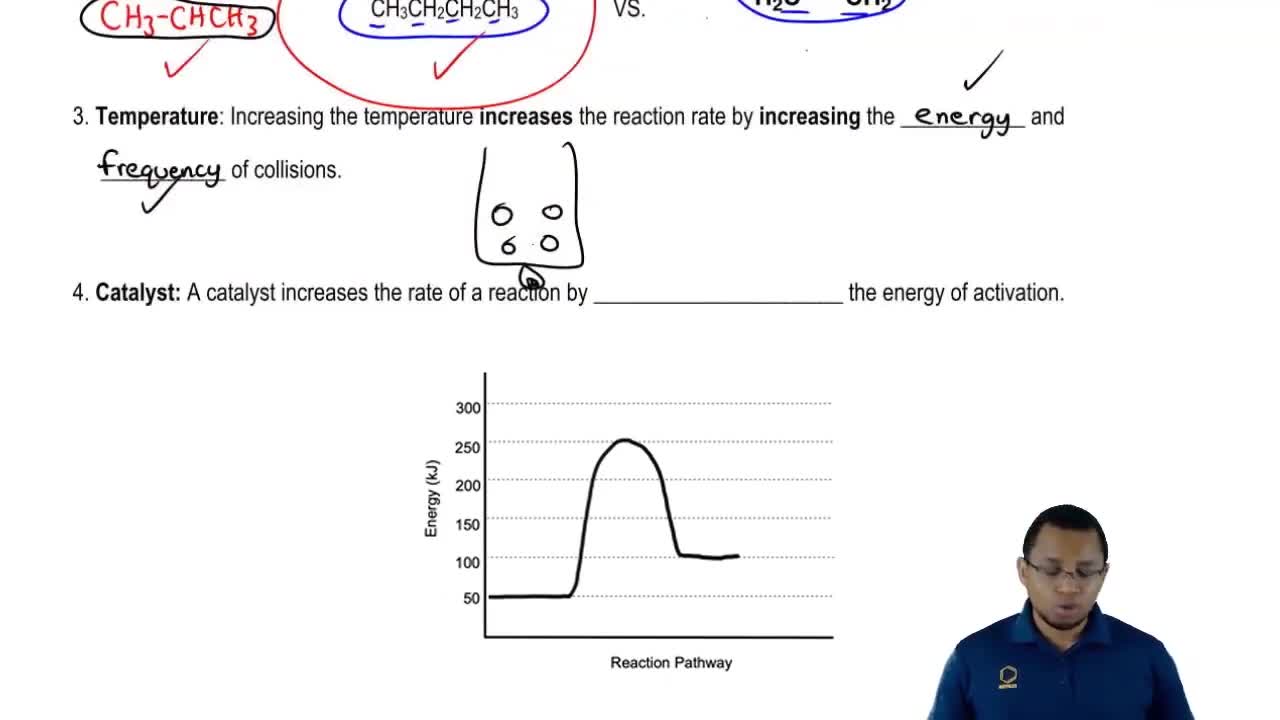
Factors that can affect the rate of a reaction include temperature, concentration of reactants, surface area, and the presence of a catalyst.
Understanding the rate of a reaction is crucial for controlling industrial processes, predicting reaction behavior, and optimizing conditions for desired outcomes.
Verified video answer for a similar problem:
This video solution was recommended by our tutors as helpful for the problem above
Video duration:
1m
Play a video:
0 Comments
Key Concepts
Here are the essential concepts you must grasp in order to answer the question correctly.
Reaction Rate
The rate of a reaction refers to the speed at which reactants are converted into products in a chemical reaction. It is typically measured as the change in concentration of a reactant or product per unit time, often expressed in moles per liter per second (mol/L/s). Understanding reaction rates is crucial for predicting how quickly a reaction will occur under various conditions.
Several factors influence the rate of a chemical reaction, including temperature, concentration of reactants, surface area, and the presence of catalysts. For instance, increasing the temperature generally increases the reaction rate by providing more energy to the molecules, leading to more frequent and effective collisions. Recognizing these factors helps in controlling and optimizing reactions in both laboratory and industrial settings.
Rate laws are mathematical expressions that relate the rate of a reaction to the concentration of its reactants. They are derived from experimental data and can take the form of a simple equation, such as rate = k[A]^m[B]^n, where k is the rate constant, and m and n are the orders of the reaction with respect to reactants A and B. Understanding rate laws is essential for predicting how changes in concentration affect the reaction rate.

 1:55 minutes
 Verified step by step guidance
 01:07
01:07