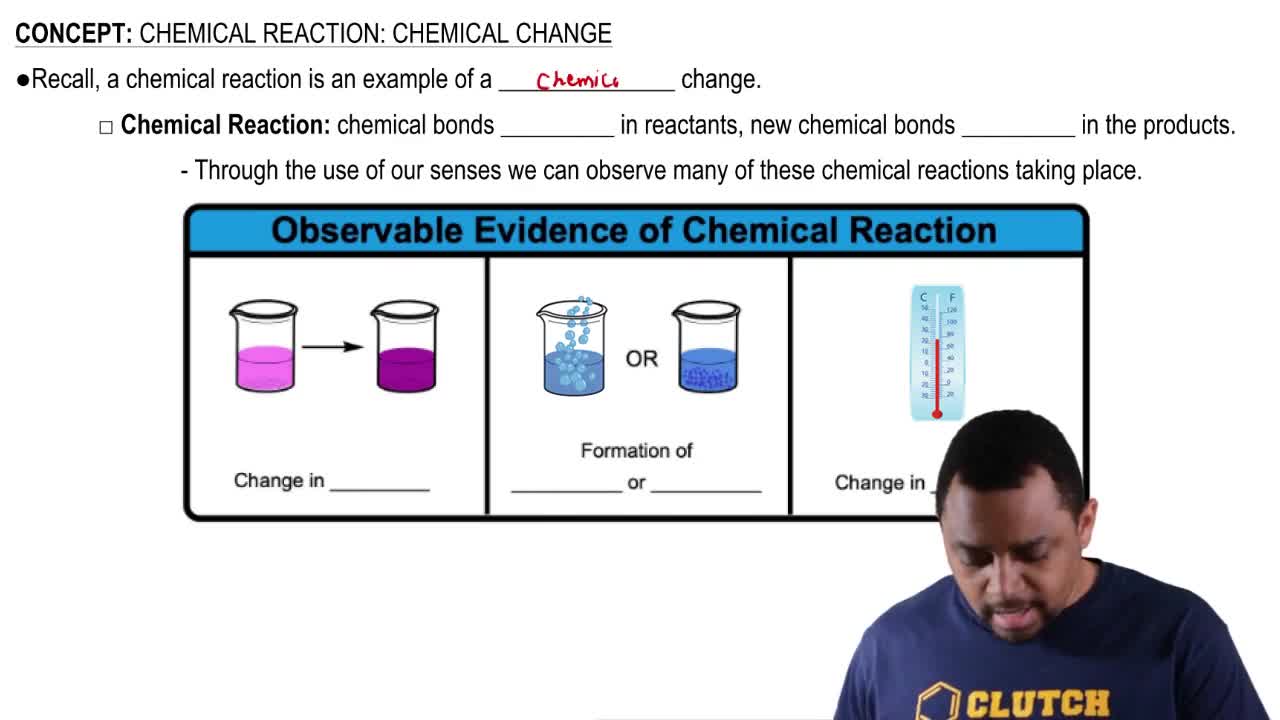
If red spheres represent oxygen atoms, blue spheres represent nitrogen atoms, and all the molecules are gases, (7.4, 7.5) Reactants → Products a. write the formula for each of the reactants and products.
Verified step by step guidance
1
Identify the colors representing each atom: red for oxygen, blue for nitrogen, and yellow for sulfur.
Examine the reactants: there are molecules with two yellow spheres and molecules with one blue and one yellow sphere.
Determine the chemical formulas for the reactants: the yellow spheres represent sulfur, so the molecule with two yellow spheres is S2, and the molecule with one blue and one yellow sphere is NS.
Examine the products: there are molecules with one blue sphere and three yellow spheres.
Determine the chemical formula for the products: the molecule with one blue and three yellow spheres is NS3.
Verified video answer for a similar problem:
This video solution was recommended by our tutors as helpful for the problem above
Video duration:
1m
Play a video:
0 Comments
Key Concepts
Here are the essential concepts you must grasp in order to answer the question correctly.
Chemical Symbols and Formulas
Chemical symbols are shorthand representations of elements, where each element is denoted by one or two letters, such as 'O' for oxygen and 'N' for nitrogen. A chemical formula indicates the types and numbers of atoms in a molecule, such as O2 for diatomic oxygen or N2 for diatomic nitrogen. Understanding how to write these symbols and formulas is essential for accurately representing chemical substances.
Molecular structure refers to the arrangement of atoms within a molecule, including how they are bonded together. In the context of the question, the image shows different arrangements of red (oxygen) and blue (nitrogen) spheres, which represent the molecular structures of the reactants and products. Recognizing these structures helps in identifying the correct chemical formulas for the substances involved.
In a chemical reaction, reactants are the starting substances that undergo transformation, while products are the substances formed as a result of the reaction. The question involves identifying the reactants and products based on the molecular models provided. Understanding the distinction between these two categories is crucial for writing balanced chemical equations and formulas.

 1:19 minutes
 Verified step by step guidance
 02:04
02:04