Write electron-dot symbols to show the number of covalent bonds and the lone pairs of electrons in the molecules that are formed by reactions between the atoms in Problem 4.34.
Verified step by step guidance
1
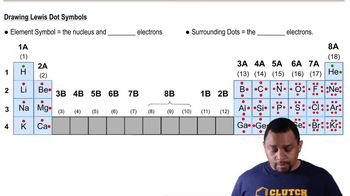
Identify the atoms involved in Problem 4.34 and determine their valence electrons using the periodic table.
For each atom, draw the electron-dot symbol, representing valence electrons as dots around the element symbol.
Determine how many electrons each atom needs to achieve a full outer shell, typically 8 electrons for most elements (octet rule), except for hydrogen which needs 2.
Identify potential covalent bonds by pairing unpaired electrons from different atoms to achieve full outer shells.
Draw the final electron-dot structure, showing shared pairs of electrons as lines (covalent bonds) and unshared pairs as dots (lone pairs) around each atom.
Verified video answer for a similar problem:
This video solution was recommended by our tutors as helpful for the problem above
Video duration:
4m
Play a video:
0 Comments
Key Concepts
Here are the essential concepts you must grasp in order to answer the question correctly.
Covalent Bonds
Covalent bonds are formed when two atoms share one or more pairs of electrons. This sharing allows each atom to attain a stable electron configuration, typically resembling that of noble gases. The number of shared electron pairs determines the bond order, with single, double, and triple bonds representing one, two, and three pairs of shared electrons, respectively.
Electron-dot symbols, also known as Lewis dot structures, visually represent the valence electrons of an atom. Each dot corresponds to a valence electron, and the symbols help illustrate how atoms bond and the arrangement of electrons in a molecule. These diagrams are essential for understanding molecular structure, including the number of bonds and lone pairs present.
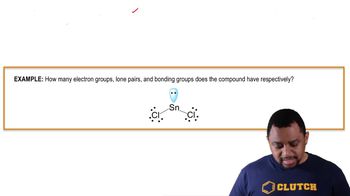
Lone pairs are pairs of valence electrons that are not involved in bonding and remain localized on a single atom. They play a crucial role in determining the geometry and reactivity of molecules. In electron-dot symbols, lone pairs are typically represented as pairs of dots adjacent to the atom, indicating regions of electron density that influence molecular shape and polarity.

 4:47 minutes
 Verified step by step guidance
 01:18
01:18