Write a balanced equation for the proton transfer reaction between hydrofluoric acid (HF) and ammonia (NH₃). Identify each conjugate acid-base pair, and rewrite the equilibrium arrows to indicate if the forward or reverse reaction is favored.
Verified step by step guidance
1
Identify the reactants: Hydrofluoric acid (HF) and ammonia (NH₃).
Write the unbalanced equation for the proton transfer: HF + NH₃ \(\rightarrow\) F^- + NH₄^+.
Balance the equation: Ensure that the number of atoms and charges are balanced on both sides of the equation.
Identify the conjugate acid-base pairs: HF and F^- form one pair, NH₃ and NH₄^+ form the other pair.
Determine the direction of the equilibrium: Compare the strengths of the acids and bases to decide if the forward or reverse reaction is favored.
Verified video answer for a similar problem:
This video solution was recommended by our tutors as helpful for the problem above
Video duration:
4m
Play a video:
0 Comments
Key Concepts
Here are the essential concepts you must grasp in order to answer the question correctly.
Acid-Base Theory
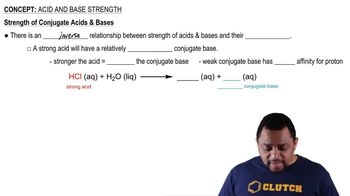
Acid-base theory explains the behavior of acids and bases in chemical reactions. According to the Brønsted-Lowry theory, an acid is a proton donor, while a base is a proton acceptor. In the reaction between hydrofluoric acid (HF) and ammonia (NH₃), HF donates a proton to NH₃, forming the conjugate base fluoride (F⁻) and the conjugate acid ammonium (NH₄⁺). Understanding this theory is essential for identifying conjugate acid-base pairs.
Conjugate acid-base pairs consist of two species that differ by the presence of a proton (H⁺). In the reaction between HF and NH₃, HF and F⁻ form one conjugate pair, while NH₃ and NH₄⁺ form another. Recognizing these pairs is crucial for analyzing the reaction's dynamics and understanding how the strength of acids and bases influences the equilibrium position.
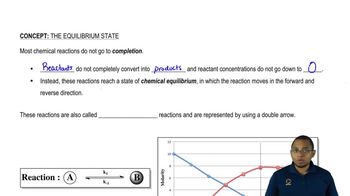
Chemical equilibrium occurs when the rates of the forward and reverse reactions are equal, resulting in constant concentrations of reactants and products. In the context of the HF and NH₃ reaction, the equilibrium can be shifted depending on the relative strengths of the acids and bases involved. By rewriting the equilibrium arrows to indicate whether the forward or reverse reaction is favored, one can predict the direction of the reaction based on the stability of the conjugate acids and bases.

 4:24 minutes
 Verified step by step guidance
 03:11
03:11