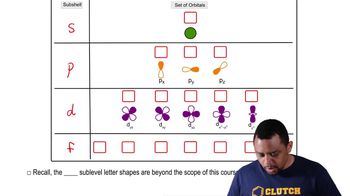
What is the total number of orbitals in the third shell? The fourth shell?
Verified step by step guidance
1
Understand that the number of orbitals in a shell is determined by the formula: \( n^2 \), where \( n \) is the principal quantum number representing the shell.
For the third shell, set \( n = 3 \). Calculate the number of orbitals using the formula \( n^2 \).
For the fourth shell, set \( n = 4 \). Calculate the number of orbitals using the formula \( n^2 \).
Recognize that each orbital can hold a maximum of 2 electrons, which is useful for understanding electron capacity but not directly needed for this problem.
Summarize the results: The third shell has \( 3^2 \) orbitals, and the fourth shell has \( 4^2 \) orbitals.
Verified video answer for a similar problem:
This video solution was recommended by our tutors as helpful for the problem above
Video duration:
3m
Play a video:
0 Comments
Key Concepts
Here are the essential concepts you must grasp in order to answer the question correctly.
Electron Shells
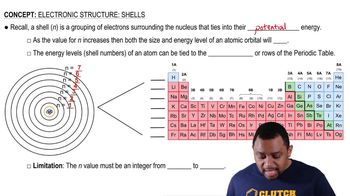
Electron shells are defined energy levels around an atom's nucleus where electrons reside. Each shell is designated by a principal quantum number (n), which indicates its distance from the nucleus. The third shell corresponds to n=3, while the fourth shell corresponds to n=4, with each shell having a specific capacity for electrons.
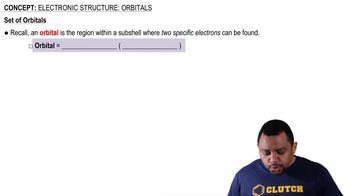
Orbitals are regions within an electron shell where there is a high probability of finding an electron. Each shell contains a set number of orbitals, which can be s, p, d, or f types, each with different shapes and capacities. The total number of orbitals in a shell can be calculated using the formula n^2, where n is the principal quantum number.
To determine the total number of orbitals in a given shell, the formula n^2 is applied. For the third shell (n=3), the total number of orbitals is 3^2 = 9. For the fourth shell (n=4), the total number of orbitals is 4^2 = 16. This calculation is essential for understanding electron configurations and the distribution of electrons in an atom.

 3:58 minutes
 Verified step by step guidance
 02:29
02:29