Join thousands of students who trust us to help them ace their exams!
Multiple Choice
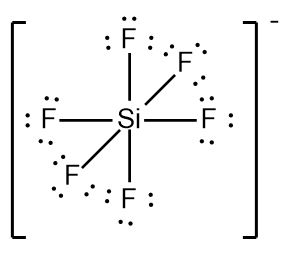
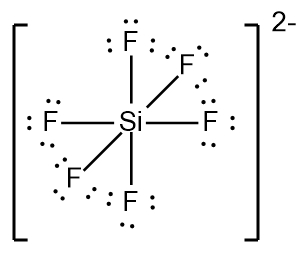
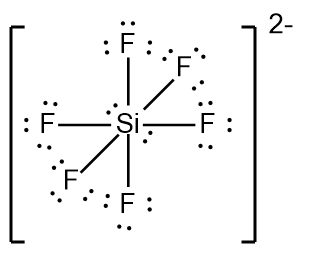
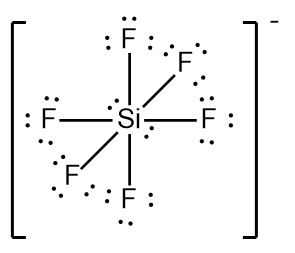
Metalloids can sometimes adopt the bonding preferences of similar nonmetals. Based on your knowledge of expanded octets, draw the Lewis Dot Structure for the following ion, SiF62–.
A
B
C
D
0 Comments
Verified step by step guidance
1
Identify the central atom in the ion, which is silicon (Si) in this case.
Determine the total number of valence electrons available. Silicon has 4 valence electrons, and each fluorine atom has 7 valence electrons. Since there are 6 fluorine atoms, calculate the total valence electrons from fluorine as 6 * 7 = 42. Add the 2 extra electrons from the 2- charge, giving a total of 4 (from Si) + 42 (from F) + 2 (extra) = 48 valence electrons.
Place the silicon atom in the center and arrange the six fluorine atoms around it. Draw single bonds between the silicon and each fluorine atom. Each bond represents 2 electrons, so 6 bonds use 12 electrons.
Distribute the remaining electrons to satisfy the octet rule for each fluorine atom. Each fluorine needs 8 electrons in total, including the bonding pair. Since each fluorine already has 2 electrons from the bond, place 6 more electrons (3 lone pairs) around each fluorine.
Check the formal charges to ensure the structure is correct. Silicon can have an expanded octet, so it can accommodate more than 8 electrons. Ensure the overall charge of the ion is -2, which is consistent with the given ion SiF6^2-.




 Verified step by step guidance

