Skip to main content
Introduction to Chemistry
My Course
Learn
Exam Prep
AI Tutor
Study Guides
Flashcards
Explore
Try the app
My Course
Learn
Exam Prep
AI Tutor
Study Guides
Flashcards
Explore
Try the app
Back
Periodic Table: Element Symbols definitions
You can tap to flip the card.
Periodic Table
You can tap to flip the card.
👆
Periodic Table
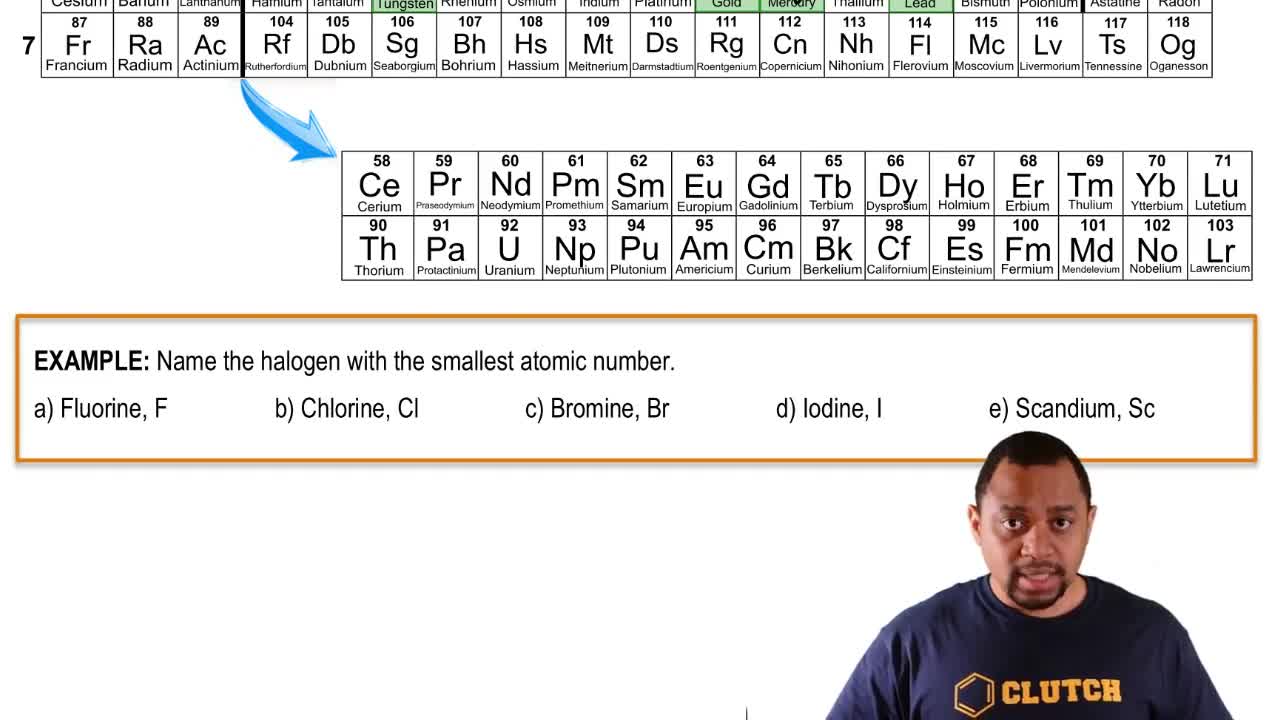
A grid organizing all known elements by increasing atomic number, grouping those with similar chemical properties in columns.
Track progress
Control buttons has been changed to "navigation" mode.
1/14
Related flashcards
Related practice
Recommended videos
Periodic Table: Element Symbols quiz #1
Periodic Table: Element Symbols
40 Terms
Periodic Table: Element Symbols quiz #2
Periodic Table: Element Symbols
17 Terms
Periodic Table: Element Symbols
4. Atoms and Elements
5 problems
Topic
Periodic Table: Classifications
4. Atoms and Elements
5 problems
Topic
4. Atoms and Elements - Part 1 of 2
12 topics
35 problems
Chapter
4. Atoms and Elements - Part 2 of 2
1 topic
3 problems
Chapter
Guided course
04:01
Periodic Table: Symbols Concept
9124
views
72
rank
Guided course
01:01
Periodic Table: Symbols Example 1
6973
views
49
rank
Terms in this set (14)
Hide definitions
Periodic Table
A grid organizing all known elements by increasing atomic number, grouping those with similar chemical properties in columns.
Element
A pure substance consisting of only one type of atom, each defined by a unique number of protons.
Element Symbol
A one- or two-letter abbreviation representing an element, often derived from its English or Latin name.
Atomic Number
A value symbolized by Z, indicating the number of protons in the nucleus of an atom.
Group
A vertical column on the periodic table where elements share similar chemical properties.
Periodic Law
A principle stating that elemental properties recur periodically when arranged by increasing atomic number.
Chemical Property
A characteristic that determines how an element interacts or reacts with other substances.
Latin Name
An older, often historical, designation from which some element symbols are derived, differing from their English names.
Proton
A positively charged subatomic particle found in the nucleus, determining the atomic number of an element.
Prediction
The ability to foresee the existence of undiscovered elements based on patterns in the periodic table.
Column
A vertical arrangement in the periodic table, also called a group, where elements exhibit similar behaviors.
Row
A horizontal sequence in the periodic table, also known as a period, where atomic numbers increase from left to right.
Abbreviation
A shortened form, such as an element symbol, used for concise representation of longer names.
Discovery
The process of identifying and naming new elements, often predicted by gaps in the periodic table.
 BackBack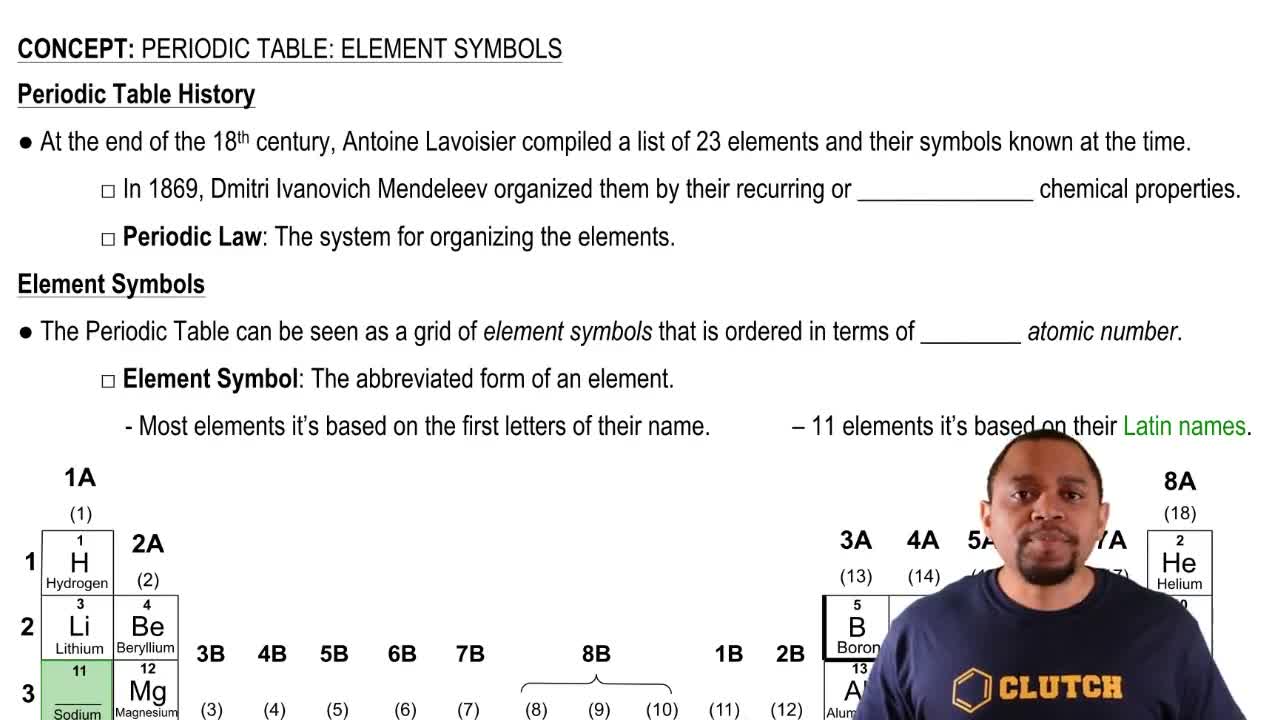
 04:01
04:01