 Back
BackIntroduction to Chemistry: Acids and Bases
 01:30
01:30
Terms in this set (20)
Common sources include vinegar (acetic acid), lemon (citric acid), tomato (oxalic acid), apple (malic acid), grapes (tartaric acid), milk (lactic acid), and ants (formic acid).
Acids have a sour taste.
Acids dissolve many metals, such as zinc, producing hydrogen gas. Example: Zn + 2HCl → ZnCl2 + H2.
Acids turn blue litmus paper red.
Hydrochloric acid (HCl), sulfuric acid (H2SO4), phosphoric acid (H3PO4), and acetic acid (CH3COOH).
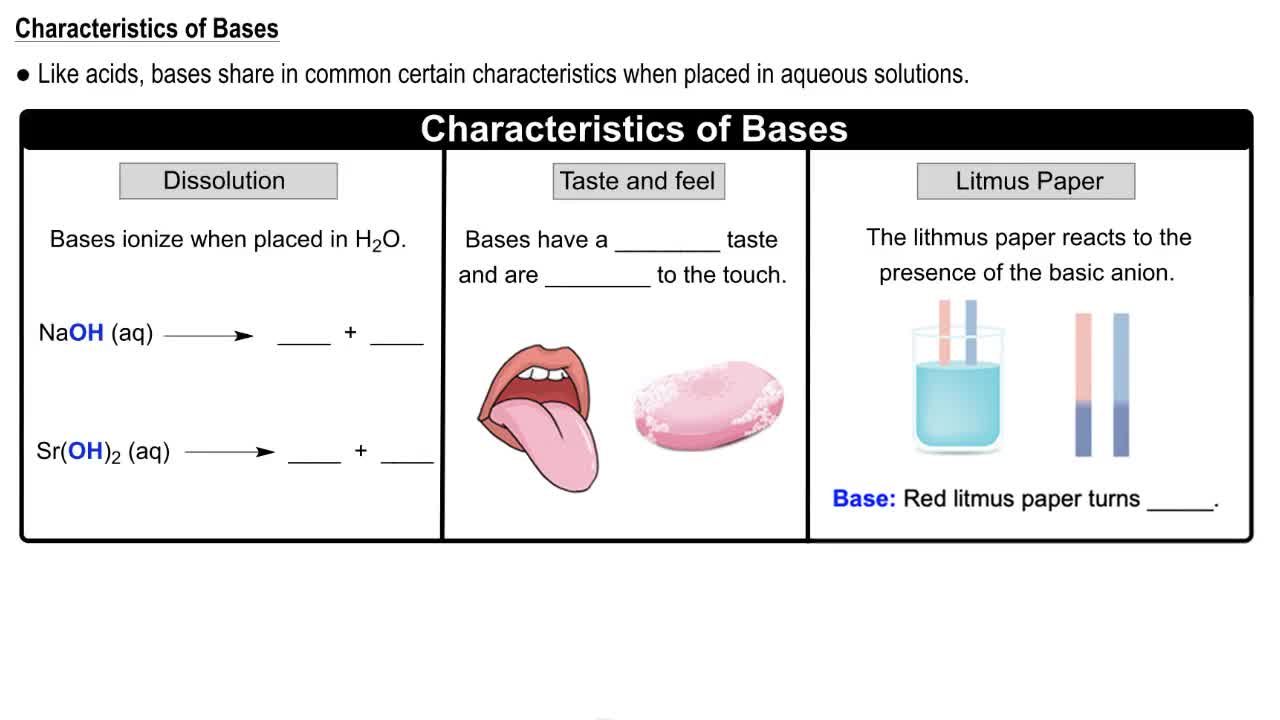
Bases have a bitter taste, a slippery feel, and turn red litmus paper blue.
Bases react with oils on the skin to form soaplike substances, causing a slippery feel.
Sodium hydroxide (NaOH), potassium hydroxide (KOH), and sodium bicarbonate (NaHCO3).
Acidic: blue litmus turns red; red stays red. Basic: red litmus turns blue; blue stays blue. Neutral: both stay their original colors.
An acid produces \(H^+\) ions in aqueous solution.
A base produces \(OH^-\) ions in aqueous solution.
The \(H^+\) from the acid combines with the \(OH^-\) from the base to form water.
Water and a salt, where the salt contains the cation from the base and the anion from the acid.
pH < 7 is acidic, pH = 7 is neutral, and pH > 7 is basic.
pH = −log[\(H_3O^+\)]
Lower pH means higher acidity; higher pH means higher basicity.
Between 7.35 and 7.45, which is slightly basic and tightly regulated for health.
Both concentrations are equal at 1.0 × 10⁻⁷ M.
[\(H_3O^+\)][\(OH^-\)] = 1.0 × 10⁻¹⁴
Acids ionize to produce \(H^+\) and their conjugate base ions. Example: HCl (aq) → \(H^+\) (aq) + Cl− (aq).