Skip to main content
Introduction to Chemistry
My Course
Learn
Exam Prep
AI Tutor
Study Guides
Flashcards
Explore
Try the app
My Course
Learn
Exam Prep
AI Tutor
Study Guides
Flashcards
Explore
Try the app
Back
Introduction to Chemistry: Electrons in Atoms and the Periodic Table
You can tap to flip the card.
Why was the Hindenburg airship filled with hydrogen gas?
You can tap to flip the card.
👆
Why was the Hindenburg airship filled with hydrogen gas?
Hydrogen gas was used for buoyancy because it is less dense than air, but it is highly reactive and flammable.
Track progress
Control buttons has been changed to "navigation" mode.
1/25
Recommended videos
Guided course
02:53
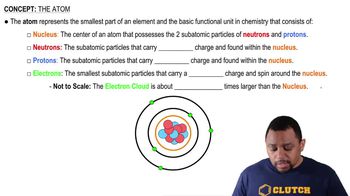
The Atom (Simplified) Concept 2
10865
views
147
rank
Guided course
01:44
The Atom (Simplified) Concept 1
6481
views
115
rank
Guided course
02:52
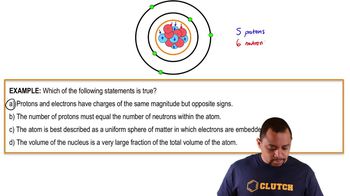
The Atom (Simplified) Example 1
11562
views
148
rank
Terms in this set (25)
Hide definitions
Why was the Hindenburg airship filled with hydrogen gas?
Hydrogen gas was used for buoyancy because it is less dense than air, but it is highly reactive and flammable.
What makes helium gas inert compared to hydrogen?
Helium has a highly stable electron configuration with two protons and two electrons, resulting in a full outer shell that makes it inert.
What does Mendeleev's periodic law state?
When elements are arranged by increasing atomic mass, certain sets of properties recur periodically.
What is the speed of light (c)?
Light travels through space at a constant speed of 3.0 x 10\(8\) m/s.
What is wavelength (λ) in terms of light waves?
Wavelength is the distance between adjacent wave crests.
How many colors does white light split into when passed through a prism?
White light splits into 7 colors: red, orange, yellow, green, blue, indigo, and violet.
Which visible light color has the longest wavelength and which has the shortest?
Red has the longest wavelength (~750 nm) and violet has the shortest (~400 nm).
What is frequency (ν) of a wave?
Frequency is the number of wave crests passing a point per second.
How are wavelength and frequency related?
They are inversely related: shorter wavelength means higher frequency and greater energy.
What part of the electromagnetic spectrum has the highest energy?
Gamma rays have the highest energy.
What part of the electromagnetic spectrum has the lowest energy?
Radio waves have the lowest energy.
What is the nature of light according to quantum mechanics?
Light has both wave and particle nature; particles of light are called photons.
What is an emission spectrum?
An emission spectrum shows specific wavelengths of light emitted by energized atoms.
What did Bohr's atomic model propose about electron orbits?
Electrons travel in fixed, quantized circular orbits around the nucleus.
What happens when an electron jumps from a higher to a lower energy orbit in Bohr's model?
A photon of light is emitted.
Why was the Bohr model replaced by the quantum-mechanical model?
Bohr's model could not explain emission spectra of multi-electron atoms and lacked a full description of electron behavior.
What do quantum-mechanical orbitals represent?
Orbitals represent probability maps showing where an electron is likely to be found, not exact paths.
What does the principal quantum number (n) describe?
It describes the size and energy level of an orbital; higher n means larger size and higher energy.
What does the angular quantum number (l) describe?
It describes the shape of the orbital (spherical, dumbbell, cloverleaf, etc.).
What is the Pauli exclusion principle?
An orbital can hold a maximum of two electrons with opposite spins.
What is Hund's rule?
Electrons occupy orbitals of the same energy singly first, with parallel spins, before pairing.
How many valence electrons does sulfur have in the configuration 1s²2s²2p⁶3s²3p⁴?
Sulfur has 6 valence electrons and 10 core electrons.
What is the general valence shell electron configuration of alkali metals (Group 1A)?
ns¹, and they tend to lose one electron to form +1 cations.
What is the general valence shell electron configuration of halogens (Group 7A)?
ns²np⁵, and they tend to gain one electron to form -1 anions.
Why are noble gases generally inert?
They have filled s and p orbitals with 8 valence electrons (except helium), resulting in stable electron configurations.
 BackBack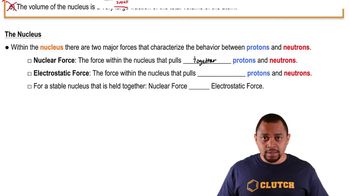
 02:53
02:53