 Back
BackIntroduction to Chemistry: Liquids, Solids, and Intermolecular Forces
 06:36
06:36

Terms in this set (20)
Intramolecular forces exist within a molecule, bond atoms together, and influence chemical properties. Examples include ionic and covalent bonds.
Intermolecular forces exist between molecules and influence physical properties. They hold liquid and solid molecules together.
Intermolecular forces are electrostatic in origin.
Intermolecular forces are between molecules and are weaker than chemical bonds.
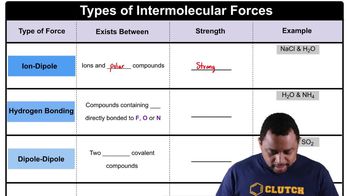
Dipole-Dipole, Hydrogen Bonding, London Dispersion (van der Waals), and Ion-Dipole forces.
London dispersion forces are present between all molecules.
Hydrogen bonding occurs between such compounds.
London dispersion forces dominate between two nonpolar covalent compounds.
Ion-dipole forces exist between ions and polar compounds.
London dispersion forces increase in strength with increasing molecular mass.
Stronger intermolecular forces lead to higher boiling points, melting points, viscosity, and surface tension.
Vapor pressure is the pressure exerted by a vapor at the surface of a liquid, representing an equilibrium between evaporation and condensation.
Crystalline solids have atoms, ions, or molecules arranged in a highly ordered pattern.
Amorphous solids have particles arranged randomly without a clear pattern.
Covalent bonds are the major electrostatic forces within NH3 molecules.
Ionic solids are held by attraction between positive and negative ions, while molecular solids are held by intermolecular forces between molecules.
Steel is an alloy, a metallic solid made of metal atoms bonded by metallic bonds.
The specific heat of liquid water is 4.184 J/g·°C.
The heat of fusion of water is 334 J/g.
The heat of vaporization of water is 2260 J/g.