Skip to main content
Introduction to Chemistry
My Course
Learn
Exam Prep
AI Tutor
Study Guides
Flashcards
Explore
Try the app
My Course
Learn
Exam Prep
AI Tutor
Study Guides
Flashcards
Explore
Try the app
Back
Introduction to Chemistry: Liquids, Solids, Intermolecular Forces, and Solutions
You can tap to flip the card.
What are intermolecular forces?
You can tap to flip the card.
👆
What are intermolecular forces?
Intermolecular forces are
attractive forces between molecules
that influence properties like taste, shape of liquids, and states of matter.
Track progress
Control buttons has been changed to "navigation" mode.
1/20
Recommended videos
Guided course
06:36
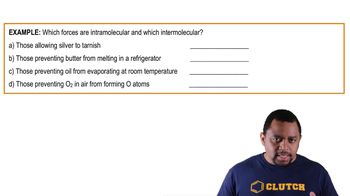
Intermolecular Forces (Simplified) Concept 2
2559
views
15
rank
Guided course
01:54
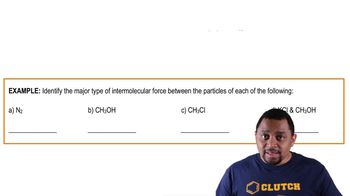
Intermolecular Forces (Simplified) Example 1
725
views
15
rank
Guided course
02:25
Intermolecular Forces (Simplified) Example 2
2380
views
9
rank
1
comments
Terms in this set (20)
Hide definitions
What are intermolecular forces?
Intermolecular forces are
attractive forces between molecules
that influence properties like taste, shape of liquids, and states of matter.
Name the four fundamental types of intermolecular forces in order of increasing strength.
Dispersion force, dipole–dipole force, hydrogen bond, and ion–dipole force.
What causes dispersion forces?
Dispersion forces arise from
fluctuations in electron distribution
within atoms or molecules, creating instantaneous dipoles.
How does molar mass affect dispersion forces?
Dispersion forces
increase with increasing molar mass
because larger electron clouds polarize more easily.
What is the dipole–dipole force?
An attractive force between
permanent dipoles in polar molecules
, where positive ends attract negative ends of neighboring molecules.
Which molecules exhibit hydrogen bonding?
Polar molecules with hydrogen bonded directly to fluorine, oxygen, or nitrogen, such as HF, NH3, and H2O.
Why does water have a high boiling point relative to its molar mass?
Because of strong
hydrogen bonding
between water molecules, requiring more energy to break.
What are ion–dipole forces?
Attractive forces between
ions and polar molecules
, important in solutions of ionic compounds in polar solvents like water.
How do intermolecular forces affect the state of matter?
Stronger intermolecular forces favor solids or liquids by holding molecules close; weaker forces favor gases with molecules far apart.
Describe molecular arrangement and movement in solids, liquids, and gases.
Solids: tightly packed, vibrate in place; Liquids: close but flow past each other; Gases: far apart, move freely.
What is melting and freezing in terms of physical changes?
Melting: solid to liquid, endothermic; Freezing: liquid to solid, exothermic; both are physical changes.
Define evaporation and condensation.
Evaporation: liquid to gas, endothermic; Condensation: gas to liquid, exothermic; both are physical changes.
How to determine if a molecule has dipole–dipole forces?
Check if molecule has polar bonds and if their dipoles add to a net dipole moment (molecule is polar).
What is miscibility?
The ability of liquids to mix without separating; polar liquids are miscible with polar liquids, nonpolar with nonpolar.
What is a solution, solvent, and solute?
Solution: homogeneous mixture; Solvent: majority component; Solute: minority component dissolved in solvent.
What are electrolytes and nonelectrolytes?
Electrolytes produce ions in solution and conduct electricity; nonelectrolytes dissolve as molecules and do not conduct electricity.
Define molarity and its formula.
Molarity (M) = moles of solute / liters of solution; it measures solution concentration.
How does a solid dissolve in water?
Solvent–solute attractions overcome solute–solute and solvent–solvent attractions, allowing solute particles to disperse.
What is the difference between saturated and unsaturated solutions?
Saturated contains maximum dissolved solute; adding more causes precipitate. Unsaturated can dissolve more solute.
How to calculate molarity from grams of solute and volume of solution?
Convert grams to moles using molar mass, then divide moles by liters of solution.
 BackBack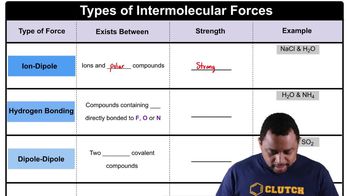
 06:36
06:36