Chuggy wants to earn a high grade in his microeconomics class, but also loves going to parties and binge drinking. The first graph illustrates Chuggy's PPF. The second graph denotes his MB curve from binge drinking. What is Chuggy's marginal cost of binge drinking if he parties for three hours a week?
Table of contents
- 1. Introduction to Macroeconomics2h 3m
- 2. Introductory Economic Models1h 9m
- 3. Supply and Demand3h 23m
- Introduction to Supply and Demand4m
- The Basics of Demand6m
- Individual Demand and Market Demand3m
- Shifting Demand38m
- The Basics of Supply2m
- Individual Supply and Market Supply6m
- Shifting Supply28m
- Overview of Supply and Demand Shifts7m
- Supply and Demand Together: Equilibrium, Shortage, and Surplus8m
- Supply and Demand Together: One-sided Shifts20m
- Supply and Demand Together: Both Shift34m
- Supply and Demand: Quantitative Analysis40m
- 4. Elasticity2h 25m
- Percentage Change and Price Elasticity of Demand18m
- Elasticity and the Midpoint Method20m
- Price Elasticity of Demand on a Graph11m
- Determinants of Price Elasticity of Demand6m
- Total Revenue Test13m
- Total Revenue Along a Linear Demand Curve14m
- Income Elasticity of Demand23m
- Cross-Price Elasticity of Demand11m
- Price Elasticity of Supply12m
- Price Elasticity of Supply on a Graph3m
- Elasticity Summary9m
- 5. Consumer and Producer Surplus; Price Ceilings and Price Floors3h 11m
- WIllingness to Pay and Consumer Surplus18m
- Willingness to Sell and Producer Surplus12m
- Economic Surplus and Efficiency18m
- Quantitative Analysis of Consumer and Producer Surplus at Equilibrium28m
- Price Ceilings, Price Floors, and Black Markets38m
- Quantitative Analysis of Price Ceilings and Floors: Finding Points20m
- Quantitative Analysis of Price Ceilings and Floors: Finding Areas54m
- 6. Introduction to Taxes1h 29m
- 7. Externalities54m
- 8. The Types of Goods1h 3m
- 9. International Trade1h 16m
- 10. Measuring National Output and Income 54m
- 11. Unemployment and Inflation1h 34m
- Labor Force and Unemployment10m
- Types of Unemployment12m
- Unemployment: Minimum Wage Laws and Efficiency Wages7m
- Inflation and Consumer Price Index (CPI)16m
- Using CPI to Adjust for Inflation7m
- Problems with the Consumer Price Index (CPI)5m
- Nominal Income and Real Income12m
- Nominal Interest, Real Interest, and the Fisher Equation5m
- Who is Affected by Inflation?5m
- Demand-Pull and Cost-Push Inflation6m
- Costs of Inflation: Shoe-leather Costs and Menu Costs4m
- 12. Productivity and Economic Growth1h 4m
- 13. The Financial System1h 30m
- 14. Income and Consumption57m
- 15. Deriving the Aggregate Expenditures Model1h 14m
- 16. Aggregate Demand and Aggregate Supply Analysis1h 22m
- Aggregate Demand17m
- Deriving Aggregate Demand from the Aggregate Expenditure Model12m
- Shifting Aggregate Demand4m
- Long Run Aggregate Supply9m
- Short Run Aggregate Supply7m
- Shifting Short Run Aggregate Supply8m
- AD-AS Model: Equilibrium in the Short Run and Long Run5m
- AD-AS Model: Shifts in Aggregate Demand18m
- 17. The Monetary System58m
- The Functions of Money; The Kinds of Money8m
- Defining the Money Supply: M1 and M22m
- Required Reserves and the Deposit Multiplier8m
- Introduction to the Federal Reserve8m
- The Federal Reserve and the Money Supply11m
- History of the US Banking System9m
- The Financial Crisis of 2007-2009 (The Great Recession)10m
- 18. Monetary Policy1h 26m
- 19. Fiscal Policy52m
- 20. Tradeoffs Between Inflation and Unemployment1h 2m
- 21. Open-Economy Macroeconomics1h 44m
- Balance of Payments: Introduction5m
- Balance of Payments: Current Account8m
- Balance of Payments: Financial Account and Capital Account7m
- Net Exports Equal Net Foreign Investment7m
- Balance of Trade; Trade Deficit and Trade Surplus6m
- Exchange Rates: Introduction14m
- Exchange Rates: Nominal and Real13m
- Exchange Rates: Equilibrium8m
- Exchange Rates: Shifts in Supply and Demand11m
- Exchange Rates and Net Exports6m
- Exchange Rates: Purchasing Power Parity3m
- The Gold Standard4m
- The Bretton Woods System6m
- 22. Macroeconomic Schools of Thought40m
- 23. Dynamic AD/AS Model32m
2. Introductory Economic Models
PPF - Increasing Marginal Opportunity Costs and Allocative Efficiency
Multiple Choice
Your bakery has workers who are cookie specialists and cake specialists. After a busy weekend, your bakery is short on cookies, and you need to rebuild your cookie inventory. To do this, you decide to shift workers away from cake production and into cookie production.
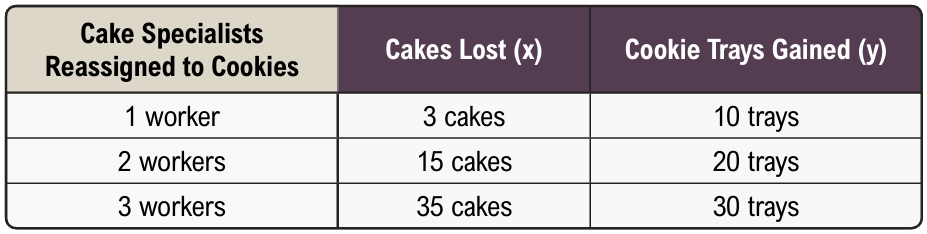
As you reassign each worker, you track how many cakes you give up and how many trays of cookies you gain:

What is the marginal opportunity cost of increasing cookie production from 10 trays to 20 trays?
A
5 cakes
B
10 cakes
C
12 cakes
D
15 cakes
2 Comments
Verified step by step guidance1
Identify the change in cookie trays produced when increasing production from 10 trays to 20 trays. From the table, this corresponds to moving from 1 worker reassigned to 2 workers reassigned, which increases cookie trays from 10 to 20 trays.
Determine the corresponding change in cakes lost when increasing cookie production from 10 trays to 20 trays. According to the table, cakes lost increase from 3 cakes to 15 cakes.
Calculate the marginal opportunity cost of increasing cookie production from 10 trays to 20 trays by finding the difference in cakes lost divided by the difference in cookie trays gained. Use the formula: \(\text{Marginal Opportunity Cost} = \frac{\Delta \text{Cakes Lost}}{\Delta \text{Cookie Trays Gained}}\).
Substitute the values from the table into the formula: \(\Delta \text{Cakes Lost} = 15 - 3\) and \(\Delta \text{Cookie Trays Gained} = 20 - 10\).
Interpret the result as the number of cakes given up for each additional tray of cookies produced between 10 and 20 trays, which represents the marginal opportunity cost.
Related Videos
Related Practice
Multiple Choice
893
views
1
comments

