Which types of payments are not included in GDP calculations, and why?
Transfer payments, such as welfare and unemployment checks, are not included in GDP because they do not reflect production of goods or services. They are only counted when spent by households on consumption.
What are the four main components used to measure GDP in the expenditure approach?
The four main components of GDP are consumption, investment, government purchases, and net exports.
What is the largest component of GDP in most economies?
Consumption is typically the largest component of GDP, representing household spending on goods and services.
What does the investment component of GDP measure?
The investment component of GDP measures spending on new capital goods such as equipment, structures, residential construction, and changes in inventory. It does not include financial investments like stocks or bonds.
Which items are included in GDP calculations?
GDP includes spending on final goods and services by households (consumption), businesses (investment), government entities (government purchases, excluding transfer payments), and net exports (exports minus imports).
Which items are not included in GDP calculations?
GDP does not include transfer payments, financial investments, or the purchase of used goods. Only spending on newly produced final goods and services is counted.
How is the net exports component of GDP calculated?
Net exports are calculated as exports (goods produced domestically and sold abroad) minus imports (goods produced abroad and sold domestically).
How are goods classified within the consumption component of GDP?
Goods in the consumption component are classified as nondurable goods (expected life less than 3 years), durable goods (expected life more than 3 years), and services (intangible acts like haircuts or legal advice).
How is a change in inventory treated within the investment component of GDP?
A change in inventory is counted as investment, reflecting goods produced but not yet sold by the end of the year. An increase in inventory adds to investment, while a decrease subtracts from it.
Why does the purchase of a newly constructed home count toward GDP, but the purchase of an old home does not?
A newly constructed home counts as residential investment because it represents new production in the economy. Buying an old home does not count since it is not new production, though improvements like a new roof would be included.
 Back
Back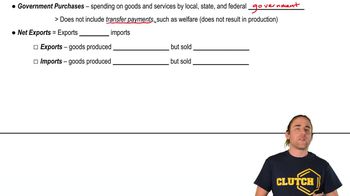
 02:12
02:12