When inflation is high, what action does the Federal Reserve take to slow the economy?
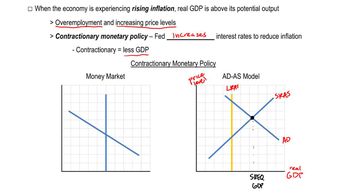
When inflation is high, the Federal Reserve aims to slow the economy by implementing contractionary monetary policy, which involves increasing interest rates and reducing the money supply.
What is the primary purpose of expansionary monetary policy?
The primary purpose of expansionary monetary policy is to increase GDP by stimulating investment, consumption, and net exports through lower interest rates and a higher money supply.
How does a restrictive (contractionary) monetary policy affect the aggregate demand curve in the ADAS model?
A restrictive (contractionary) monetary policy is designed to shift the aggregate demand curve to the left, reducing GDP and lowering the price level.
What is the main goal of contractionary monetary policy?
The main goal of contractionary monetary policy is to reduce inflation and bring GDP back to a sustainable level by increasing interest rates and decreasing the money supply.
What is expansionary monetary policy and how does it affect the economy?
Expansionary monetary policy is when the Federal Reserve increases the money supply and lowers interest rates to stimulate investment, consumption, and net exports, resulting in a rightward shift of the aggregate demand curve and higher GDP and price levels.
What is an example of a monetary policy tool used by the Federal Reserve?
An example of a monetary policy tool used by the Federal Reserve is open market operations, such as buying or selling government securities to influence the money supply and interest rates.
How does the Federal Reserve use open market operations to increase the money supply during a recession?
The Fed purchases treasury securities from the public, giving money to the public in exchange for securities. This increases the money supply, lowers interest rates, and stimulates investment and spending.
What happens to the equilibrium interest rate in the money market when the Fed implements contractionary monetary policy?
The equilibrium interest rate rises because the Fed decreases the money supply by selling securities. This higher interest rate discourages investment, consumption, and net exports.
Why might the economy experience overemployment during periods of high inflation?
Overemployment occurs because the economy is producing beyond its potential, leading to more people working and even those not typically in the labor force finding jobs. This situation is often accompanied by rising price levels and inflation.
What is the sequence of effects when the Fed lowers interest rates through expansionary monetary policy?
Lower interest rates lead to increased investment, consumption, and net exports, which together shift the aggregate demand curve to the right. This results in higher GDP and a higher price level in the ADAS model.
 Back
Back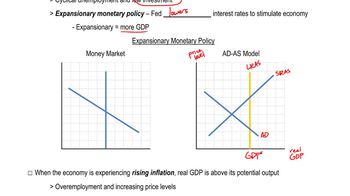
 07:42
07:42