What is an inflation-adjusted return in the context of interest rates?
An inflation-adjusted return is the real interest rate, which reflects the actual increase in purchasing power after accounting for inflation. It is calculated by subtracting the inflation rate from the nominal interest rate.
How do you calculate the real interest rate using the Fisher equation?
The real interest rate is approximately equal to the nominal interest rate minus the inflation rate, as given by the Fisher equation: Real Interest Rate ≈ Nominal Interest Rate - Inflation Rate.
How does inflation typically affect bond yields?
Inflation typically causes bond yields to increase, as investors demand higher nominal interest rates to compensate for the loss of purchasing power due to rising prices. However, if inflation rises faster than nominal yields, the real return on bonds can decrease.
How does inflation affect the purchasing power of interest earned on savings?
Inflation reduces the purchasing power of interest earned because higher prices mean the interest cannot buy as much as expected. This means the real value of the interest is less than the nominal amount received.
What is the difference between the nominal interest rate and the real interest rate?
The nominal interest rate is the stated rate provided by a bank or lender, not adjusted for inflation. The real interest rate adjusts the nominal rate for inflation to reflect the actual increase in purchasing power.
If a consumer has \$1,000 and the price of widgets is \$10, how many widgets can they buy at the start of the year?
They can buy 100 widgets at the start of the year. This is calculated by dividing \$1,000 by the \$10 price per widget.
After receiving 5% interest and facing 2.5% inflation, how many widgets can the consumer buy at the end of the year if the new widget price is \$10.25?
The consumer can buy 102.44 widgets at the end of the year. This is found by dividing their new balance of \$1,050 by the new price of \$10.25 per widget.
Who is the economist credited with the equation that adjusts nominal interest rates for inflation?
The economist credited is Fisher. The equation is known as the Fisher equation.
Why is the Fisher equation considered a good estimate for the real interest rate?
The Fisher equation closely matches the actual increase in purchasing power after accounting for inflation. In the example, the calculated real interest rate nearly equaled the actual increase in widgets the consumer could buy.
What should you be able to calculate using the Fisher equation in economic situations?
You should be able to calculate the approximate real interest rate by subtracting the inflation rate from the nominal interest rate. This helps determine the true increase in purchasing power from interest earned.
 Back
Back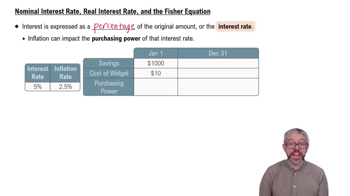
 05:05
05:05