 Back
BackMacroeconomics: Economic Growth, Financial System, and Business Cycles
 02:07
02:07
Terms in this set (20)
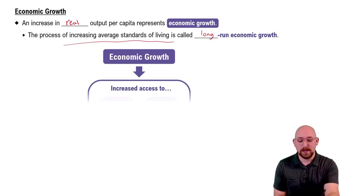
Long-run economic growth is the process by which rising productivity increases the average standard of living, measured by real GDP per capita.
Real GDP per capita is the amount of production in the economy per person, adjusted for changes in the price level.
Labor productivity growth depends on increases in capital per hour worked, technological change, and secure property rights.
The Rule of 70 estimates the number of years for an economic variable to double by dividing 70 by the growth rate percentage.
Potential GDP is the level of real GDP when all firms operate at capacity with normal hours and workforce size.
The financial system facilitates growth by channeling funds from savers to firms for investment through financial markets and intermediaries.
Financial markets are where stocks and bonds are traded; financial intermediaries like banks borrow from savers and lend to borrowers.
It provides risk sharing, liquidity, and information to help allocate funds efficiently.
In a closed economy, total savings equals investment, where savings is income minus consumption and government spending.
A conceptual market where borrowers and lenders interact to determine the real interest rate and quantity of funds loaned.
It increases demand for loanable funds, raising the real interest rate and quantity of funds loaned.
Crowding out occurs when government borrowing reduces funds available for private investment, raising interest rates and lowering investment.
The business cycle consists of alternating periods of economic expansion and recession, marked by peaks and troughs in real GDP.
A recession is a significant decline in economic activity spread across the economy lasting more than a few months, visible in production, employment, income, and trade.
Interest rates rise and wages increase faster than prices, causing firm profits to fall.
During recessions, inflation tends to fall or prices may even decline due to lower demand relative to supply.
Firms reduce production and lay off workers during recessions, and employment recovery lags behind economic recovery.
Because business cycles are not uniform, leading indicators are unreliable, and triggering events are hard to foresee.
Increased importance of services, unemployment insurance, active government stabilization policies, and a more stable financial system.
Saving provides funds for investment, increasing productive capacity and future consumption.