 Back
BackMacroeconomics: GDP and National Income Measurement
 02:31
02:31
Terms in this set (21)
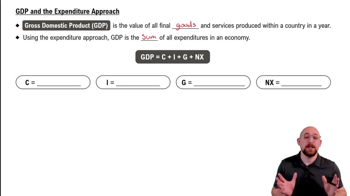
GDP is the market value of all final goods and services produced within a country during a specific period, usually one year.
Market value allows aggregation of diverse goods and services by valuing them in monetary terms using their selling prices.
Goods and services purchased by the final user, excluding intermediate goods to avoid double counting.
Yes, GDP includes all production within a country's borders regardless of ownership.
GDP measures production during a specific period, typically one year, counting only new goods and services produced in that period.
By measuring total production or total income, which are equivalent since production generates income.
Consumption (C), Investment (I), Government Purchases (G), and Net Exports (NX).
Spending by households on goods and services, excluding new houses.
Spending on new factories, machinery, additions to inventories, and new houses by firms and households.
Spending by federal, state, and local governments on goods and services, excluding transfer payments.
Exports minus imports; exports add to GDP, imports are subtracted to measure domestic production.
Summing the market value added by each firm at every production stage to avoid double counting.
It excludes household production and underground economy activities.
Because the size of household production and underground economy likely remains stable year to year.
It ignores leisure, pollution, crime, social problems, and income distribution.
Nominal GDP is valued at current prices; real GDP is valued at base-year prices to remove inflation effects.
A price level measure calculated as (Nominal GDP / Real GDP) × 100.
Production by a nation's citizens, including overseas production, unlike GDP which is location-based.
GDP minus depreciation (consumption of fixed capital).
Personal income minus personal taxes; the amount households can spend or save.
GDP measures output; GDI measures income. They can show different short-run economic signals.