 Back
BackMacroeconomics: Money, Banking, and the Federal Reserve
 01:33
01:33
Terms in this set (21)
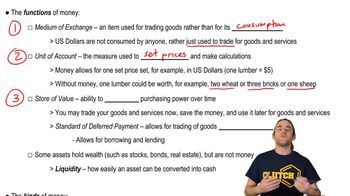
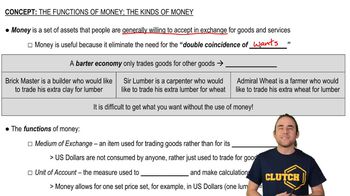
Money is any asset generally accepted in exchange for goods, services, or payment of debts.
- Medium of exchange
- Unit of account
- Store of value
- Standard of deferred payment
- Acceptable to most people
- Standardized quality
- Durable
- Valuable relative to weight
- Divisible
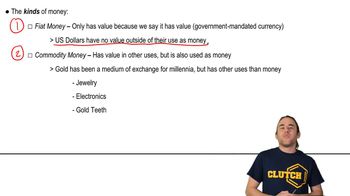
Money that has value independent of its use as money, e.g., gold, silver, cowrie shells, animal pelts.
Money authorized by a central bank or government that is not backed by a commodity and has value by government decree.
Advantage: Central banks can create money flexibly. Risk: It depends on public confidence; loss of trust makes it worthless.
M1 includes currency and checking deposits; M2 includes M1 plus savings deposits, small time deposits, and money market funds.
Debit cards access checking accounts (money), but credit cards are short-term loans and not money.
By lending out a portion of deposits (fractional reserve banking), banks create new checking deposits, expanding the money supply.
The ratio of the money supply to the monetary base, showing how deposits multiply through the banking system.
Due to changes in banks' reserve holdings and currency preferences, reducing the Fed's control over the money supply.
The Fed acts as a lender of last resort, providing loans to banks to pay depositors and stop bank runs.
A bank run is when many depositors withdraw funds simultaneously; a bank panic is when many banks experience runs at once.
A government agency that insures bank deposits up to \$250,000 to limit bank panics.
When banks take excessive risks because they expect government bailouts if they fail.
The process of transforming loans into tradable securities, allowing banks to sell loans and raise funds.
Nonbank financial firms like investment banks, hedge funds, and money market funds that provide credit outside traditional banks.
A theory linking money supply, velocity, price level, and real output via the equation \(M \times V = P \times Y\).
Inflation rate equals money supply growth minus real output growth, assuming constant velocity.
Very high inflation occurs when the money supply grows much faster than real GDP, often due to government financing deficits by money creation.
Germany in the early 1920s experienced hyperinflation when the government expanded money supply to pay war reparations, making the mark worthless.