 Back
BackMacroeconomics: Money, Banks, and the Bank of Canada
 01:33
01:33
Terms in this set (20)
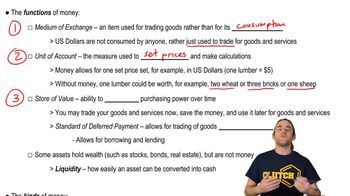
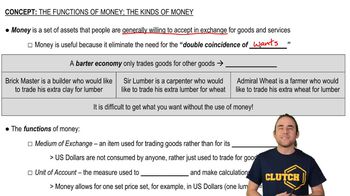
Medium of exchange, unit of account, and store of value.
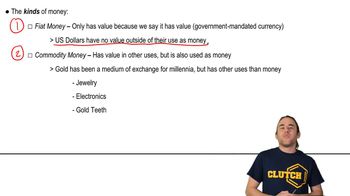
Commodity money has intrinsic value (e.g., gold coins), while fiat money has no intrinsic value and is used because of government decree (e.g., Canadian dollar).
The quantity of money available in the economy, including currency and demand deposits accessible on demand.
M1+ includes currency, demand deposits, and checkable deposits; M2 includes M1+ plus savings deposits, small time deposits, and money market mutual funds.
The central bank of Canada that oversees the banking system and regulates the money supply through monetary policy.
No, because credit card purchases are loans from banks, not money itself. Only when the credit card bill is paid does money move.
Banks keep a fraction of deposits as reserves and loan out the rest, creating new deposits and increasing the money supply.
The fraction of deposits that banks hold as reserves, expressed as total reserves divided by total deposits.
Banks hold all deposits as reserves and make no loans, so the money supply equals the currency held by the public.
Money multiplier = \(\frac{1}{R}\), where R is the reserve ratio.
Each dollar of reserves can support \$10 of money supply, so \$100 of reserves can create \$1000 of money.
\(M \times V = P \times Y\), where M is money supply, V is velocity, P is price level, and Y is real output.
The average number of times each dollar in the money supply is used to purchase goods and services included in GDP.
It assumes the velocity of money is constant over time.
Inflation rate = Growth rate of money supply + Growth rate of velocity − Growth rate of real output.
There will be inflation, meaning the price level rises.
Very high inflation (e.g., over 50% per month) caused by central banks increasing the money supply far beyond real GDP growth.
Money loses value rapidly, people avoid holding it, and economies often experience slow growth or recession.
The government financed reparations by selling bonds to the central bank, drastically increasing the money supply and causing hyperinflation.
Due to uncertainty about future economic conditions, banks may hold extra reserves as a precaution.