Skip to main content
Macroeconomics
My Course
Learn
Exam Prep
AI Tutor
Study Guides
Flashcards
Explore
Try the app
My Course
Learn
Exam Prep
AI Tutor
Study Guides
Flashcards
Explore
Try the app
Back
Monetary Policy and the Bank of Canada
You can tap to flip the card.
What is fractional reserve banking?
You can tap to flip the card.
👆
What is fractional reserve banking?
A banking system where banks keep less than 100% of deposits as reserves, lending out the rest.
Track progress
Control buttons has been changed to "navigation" mode.
1/21
Recommended videos
Guided course
05:05
Organization of the Federal Reserve
2153
views
18
rank
1
comments
Guided course
03:11
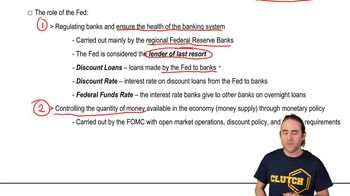
Role of the Federal Reserve
1841
views
35
rank
Terms in this set (21)
Hide definitions
What is fractional reserve banking?
A banking system where banks keep less than 100% of deposits as reserves, lending out the rest.
What is a bank run?
A situation where many depositors simultaneously withdraw money from a bank.
How does the Bank of Canada act as a lender of last resort?
It makes loans to banks that cannot borrow funds elsewhere to stop bank panics.
What are the four primary functions of the Bank of Canada?
Issue currency, act as banker to commercial banks, act as banker to the government, and control the money supply.
Name the three main tools of monetary control used by the Bank of Canada.
Open-market operations, changes in reserve requirements (not used in Canada), and changing the overnight interest rate.
How do open-market operations affect the money supply?
Buying government bonds increases money supply; selling bonds decreases it.
What is the overnight interest rate?
The interest rate on very short-term loans between commercial banks, influenced by the Bank of Canada.
What is the operating band for the overnight interest rate?
The range between the bank rate (upper limit) and the deposit rate (lower limit), typically 0.5% apart.
How does changing the overnight rate affect the money supply?
Increasing the rate discourages bank borrowing and reduces money supply; decreasing it encourages borrowing and expands money supply.
What is monetary policy?
Actions by the Bank of Canada to manage money supply and interest rates to achieve macroeconomic goals.
List the four main goals of the Bank of Canada's monetary policy.
Price stability, high employment, stability of financial markets and institutions, and economic growth.
What is inflation targeting?
Monetary policy aiming to keep inflation within a publicly announced range, typically 1-3%.
What is flexible inflation targeting?
The central bank aims to meet the inflation target over a time horizon without relying on strict rules.
How does the theory of liquidity preference explain money demand?
Money demand decreases as interest rates rise because holding money has a higher opportunity cost.
What happens to interest rates when the Bank of Canada increases the money supply?
Interest rates fall as households and firms hold more money and shift to other financial assets.
What happens to interest rates when the Bank of Canada decreases the money supply?
Interest rates rise as households and firms hold less money and sell financial assets.
How do interest rates affect consumption and investment?
Higher rates reduce consumption and investment; lower rates increase them.
How do changes in interest rates affect net exports?
Higher domestic rates increase currency value, reducing net exports; lower rates decrease currency value, increasing net exports.
What is the effect of expansionary monetary policy on aggregate demand?
It increases money supply, lowers interest rates, and shifts aggregate demand to the right, raising real GDP and price level.
What is the effect of contractionary monetary policy on aggregate demand?
It decreases money supply, raises interest rates, and shifts aggregate demand to the left, lowering real GDP and price level.
When might buying a house during a recession be a good idea?
If your job is secure, because the Bank of Canada often lowers interest rates during recessions, making borrowing cheaper.
 BackBack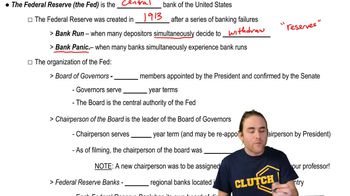
 05:05
05:05