Ch. 5 - Genetics
Norman-McKay- Microbiology: Basic and Clinical Principles 2nd Edition
Norman-McKay2nd EditionMicrobiology: Basic and Clinical PrinciplesISBN: 9780137661619Not the one you use?Change textbook
Chapter 5, Problem 25

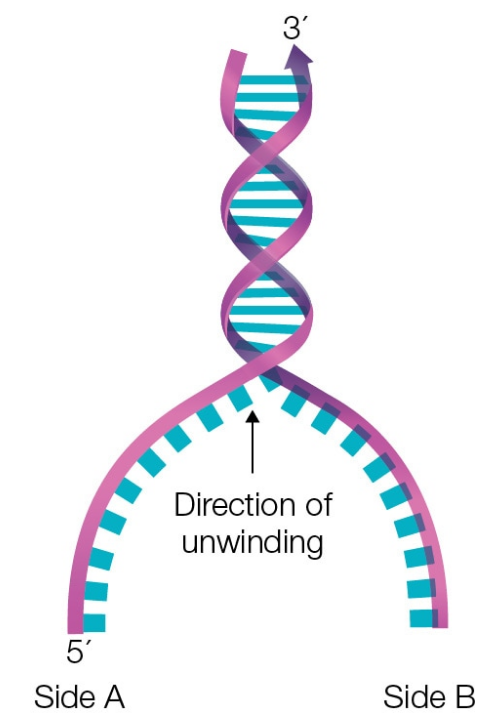
The following is a schematic of the parent DNA that is about to be repli­cated. Which side of the pictured DNA molecule (A or B) would be the leading side? Explain your answer.
DNA double helix unwinding with labeled 5' and 3' ends, showing direction of unwinding between Side A and Side B.

Verified step by step guidance
1
Identify the direction of the parent DNA strands. DNA strands are antiparallel, meaning one strand runs 5' to 3' and the complementary strand runs 3' to 5'.
Recall that DNA polymerase can only synthesize new DNA in the 5' to 3' direction, so the leading strand is synthesized continuously toward the replication fork.
Determine the direction of the replication fork movement in the schematic, which is the direction in which the DNA is being unwound and replicated.
Compare the orientation of strands A and B relative to the replication fork movement. The strand oriented 3' to 5' toward the fork will serve as the template for the leading strand synthesis.
Conclude that the side (A or B) whose template strand runs 3' to 5' toward the replication fork is the leading strand side because DNA polymerase can continuously add nucleotides in the 5' to 3' direction on this template.

Verified video answer for a similar problem:

This video solution was recommended by our tutors as helpful for the problem above.
Video duration:
1m
Was this helpful?

Key Concepts

Here are the essential concepts you must grasp in order to answer the question correctly.

DNA Replication Directionality

DNA polymerase synthesizes new DNA strands only in the 5' to 3' direction. This means that during replication, the new strand is built by adding nucleotides to the 3' end, which dictates how the leading and lagging strands are formed relative to the parental template.
Recommended video:
Guided course
03:37
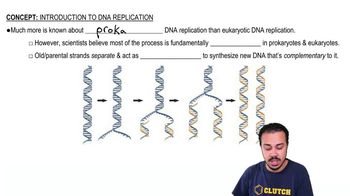
Introduction to DNA Replication

Leading vs. Lagging Strand

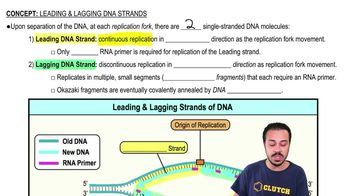
The leading strand is synthesized continuously toward the replication fork because its template runs 3' to 5'. The lagging strand is synthesized discontinuously away from the fork in short Okazaki fragments due to its 5' to 3' template orientation.
Recommended video:
Guided course
05:15
Leading & Lagging DNA Strands

Replication Fork and Template Orientation

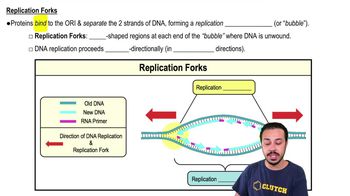
At the replication fork, the two parental DNA strands run antiparallel. Identifying which strand runs 3' to 5' toward the fork helps determine the leading strand side, as DNA polymerase moves along this template continuously.
Recommended video:
Guided course
04:00
Replication Forks