Ch. 23 - Microbial Diseases of the Cardiovascular and Lymphatic Systems
Tortora - Microbiology: An Introduction 14th Edition
Tortora14th EditionMicrobiology: An IntroductionISBN: 9780138200398Not the one you use?Change textbook
Chapter 23, Problem 9

Which of these diseases has the highest incidence in the United States?
a. Brucellosis
b. Ebola
c. Malaria
d. Plague
e. Rocky Mountain spotted fever

Verified step by step guidance
1
Step 1: Understand the term 'incidence' which refers to the number of new cases of a disease occurring in a specific population during a certain time period.
Step 2: Review the epidemiology of each disease listed, focusing on their prevalence and incidence rates in the United States.
Step 3: Recognize that diseases like Ebola and Plague are rare or have very limited outbreaks in the U.S., so their incidence is very low.
Step 4: Consider that Malaria is not endemic in the U.S. and cases are mostly imported, so its incidence is also low.
Step 5: Compare Brucellosis and Rocky Mountain spotted fever, both of which occur in the U.S., and identify which has a higher number of reported new cases annually.

Verified video answer for a similar problem:

This video solution was recommended by our tutors as helpful for the problem above.
Video duration:
1m
Was this helpful?

Key Concepts

Here are the essential concepts you must grasp in order to answer the question correctly.

Disease Incidence

Disease incidence refers to the number of new cases of a disease occurring in a specific population during a defined time period. Understanding incidence helps compare how common or rare diseases are within a region, such as the United States, and is crucial for public health planning and resource allocation.
Recommended video:
Guided course
04:57
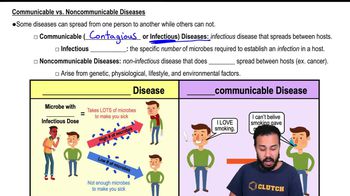
Communicable vs. Noncommunicable Diseases

Epidemiology of Listed Diseases in the U.S.

Each disease listed—Brucellosis, Ebola, Malaria, Plague, and Rocky Mountain spotted fever—has a distinct epidemiological pattern in the U.S. For example, Rocky Mountain spotted fever is endemic in certain areas and has a higher incidence compared to the others, which are either rare or mostly imported cases.
Recommended video:
Guided course
04:57
Communicable vs. Noncommunicable Diseases

Vector-borne and Zoonotic Diseases

Many diseases in the question are vector-borne or zoonotic, meaning they are transmitted by animals or arthropods like ticks or mosquitoes. Recognizing the transmission mode helps understand their distribution and incidence, as vectors' presence and human exposure influence disease frequency.
Recommended video:
Guided course
04:57
Communicable vs. Noncommunicable Diseases