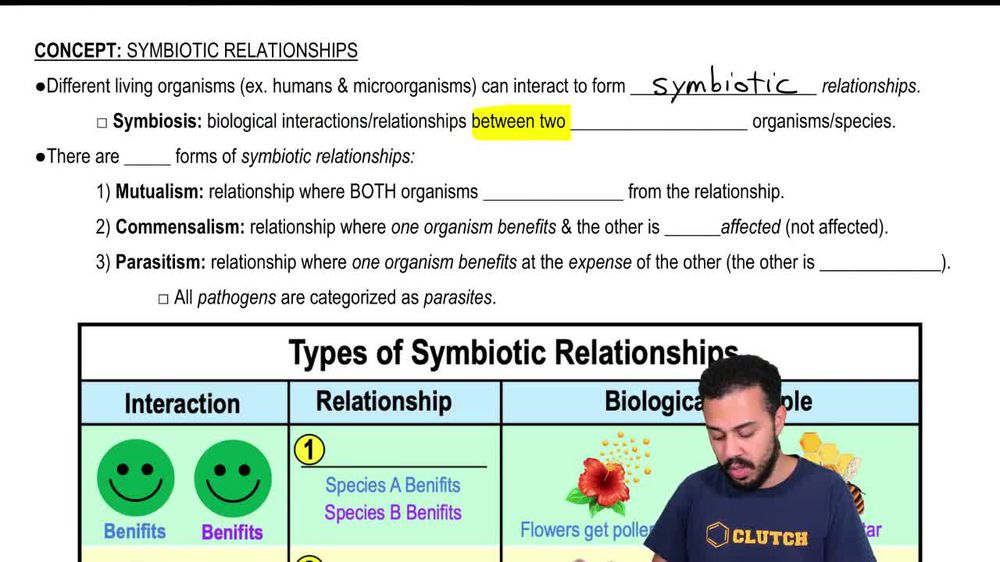
_____ Cooperation is common among microorganisms living in microhabitats.
Verified step by step guidance
1
Identify the type of cooperation commonly observed among microorganisms in microhabitats. This usually refers to interactions where different microbial species or strains work together for mutual benefit.
Recall that in microbiology, 'syntrophic cooperation' or 'syntrophy' describes a relationship where microorganisms depend on each other to degrade substances that neither can degrade alone.
Consider other types of cooperation such as mutualism, commensalism, or biofilm formation, but focus on the term that specifically highlights cooperation in microhabitats.
Understand that the blank is likely asking for a term describing this cooperative behavior, which is often 'syntrophic' or 'syntrophy' in microbial ecology.
Conclude that the correct term to fill in the blank is the one that best fits the concept of cooperative interactions among microorganisms in microhabitats.
Verified video answer for a similar problem:
This video solution was recommended by our tutors as helpful for the problem above
Video duration:
1m
Play a video:
0 Comments
Key Concepts
Here are the essential concepts you must grasp in order to answer the question correctly.
Microbial Cooperation
Microbial cooperation refers to interactions where microorganisms work together for mutual benefit, such as sharing nutrients or protecting each other from stress. This behavior enhances survival and efficiency in complex environments.
Microhabitats are small, specialized environments within larger ecosystems where microorganisms live. These niches provide unique physical and chemical conditions that influence microbial interactions and community structure.
Symbiotic Relationships
Symbiotic relationships involve close associations between different microbial species, including mutualism, commensalism, and parasitism. Cooperation often arises from mutualistic interactions that improve resource access or environmental adaptation.

 1:53 minutes
 Verified step by step guidance
 04:20
04:20