
Ch. 11 - The Prokaryotes: Domains Bacteria and Archaea
Tortora - Microbiology: An Introduction 14th Edition
Tortora14th EditionMicrobiology: An IntroductionISBN: 9780138200398Not the one you use?Change textbook
Chapter 11, Problem 1

The following outline can be used to identify important bacteria. Fill in a representative genus in the space provided.
Outline for identifying bacteria by cell wall type with categories and blanks for genus names.

Verified step by step guidance
1
Step 1: For Gram-positive endospore-forming rods, identify the genus based on oxygen requirements. Obligate anaerobes (a) are typically Clostridium, while non-obligate anaerobes (b) are usually Bacillus.
Step 2: For Gram-positive non-endospore-forming rods, distinguish by spore production and acid-fastness. Rods that produce conidiospores (c) belong to Streptomyces, and acid-fast rods (d) are from the genus Mycobacterium.
Step 3: For Gram-positive cocci, differentiate by metabolic traits. Those lacking a cytochrome system (e) are Micrococcus, and those using aerobic respiration (f) are Staphylococcus.
Step 4: For Gram-negative helical or curved cells, identify based on the presence of axial filaments. Cells with axial filaments (g) are from the genus Spirochetes (e.g., Treponema), and those without axial filaments (h) are Vibrio.
Step 5: For Gram-negative rods, classify by oxygen use. Aerobic, nonfermenting rods (i) are Pseudomonas, facultatively anaerobic rods (j) are Enterobacteriaceae (e.g., Escherichia), and bacteria lacking cell walls (k) are Mycoplasma. Obligate intracellular parasites transmitted by ticks (l) are Rickettsia, and those with reticulate bodies in host cells (m) are Chlamydia.

Verified video answer for a similar problem:

This video solution was recommended by our tutors as helpful for the problem above.
Video duration:
2m
Was this helpful?

Key Concepts

Here are the essential concepts you must grasp in order to answer the question correctly.

Gram Staining and Cell Wall Structure

Gram staining differentiates bacteria into Gram-positive and Gram-negative based on cell wall composition. Gram-positive bacteria have thick peptidoglycan layers retaining the crystal violet stain, while Gram-negative bacteria have thinner layers and an outer membrane, appearing pink after staining. This distinction is fundamental for bacterial classification and antibiotic treatment.
Recommended video:
Guided course
02:59
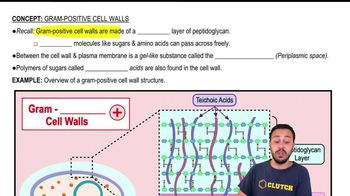
Gram-Positive Cell Walls

Bacterial Morphology and Physiology

Bacteria are classified by shape (rods, cocci, helical) and physiological traits such as oxygen requirements (obligate anaerobe, facultative anaerobe) and special features like endospore formation or acid-fastness. These characteristics help identify genera and understand their ecological roles and pathogenic potential.
Recommended video:
Guided course
02:44
Types of Bacterial Cell Morphology

Specialized Bacterial Groups and Parasitism

Some bacteria lack typical cell walls (e.g., Mycoplasma) or are obligate intracellular parasites (e.g., Rickettsia). These groups have unique adaptations, such as transmission by vectors like ticks or intracellular life cycles, which influence their identification and clinical significance.
Recommended video:
Guided course
03:37
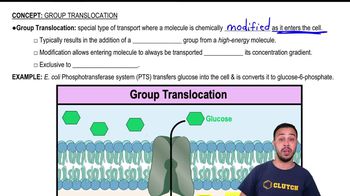
Group Translocation