Put the following substances in the order they are used in a Gram stain: Counterstain Decolorizing agent Mordant Primary stain
Verified step by step guidance
1
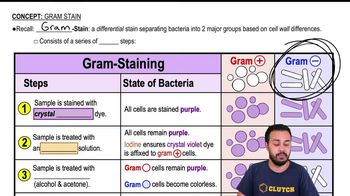
Understand the purpose of each substance in the Gram stain procedure: the primary stain colors all cells, the mordant fixes the stain, the decolorizing agent differentiates between Gram-positive and Gram-negative cells, and the counterstain colors cells that lost the primary stain.
Identify the first step: the primary stain is applied first to stain all bacterial cells, typically using crystal violet.
Next, apply the mordant, which is usually iodine; it forms a complex with the primary stain to help it adhere better to the cell wall.
Then, use the decolorizing agent, often alcohol or acetone-alcohol, to wash out the stain from Gram-negative cells but not from Gram-positive cells due to differences in their cell wall structure.
Finally, apply the counterstain, such as safranin, which stains the decolorized Gram-negative cells a different color, allowing differentiation under the microscope.
Verified video answer for a similar problem:
This video solution was recommended by our tutors as helpful for the problem above
Video duration:
3m
Play a video:
0 Comments
Key Concepts
Here are the essential concepts you must grasp in order to answer the question correctly.
Primary Stain
The primary stain is the first dye applied in the Gram staining process, typically crystal violet. It penetrates all bacterial cells, coloring them purple initially, which sets the stage for differentiating bacteria based on their cell wall properties.
The mordant, usually iodine, is applied after the primary stain to form a complex with the dye inside the cells. This complex helps fix the primary stain, making it less soluble and enhancing the retention of the dye in Gram-positive bacteria.
The decolorizing agent, often alcohol or acetone, selectively removes the primary stain from Gram-negative bacteria due to their thinner peptidoglycan layer. After decolorization, the counterstain (commonly safranin) is applied to stain the now colorless Gram-negative bacteria pink/red, completing the differentiation.