Ch. 13 - Characterizing and Classifying Viruses, Viroids, and Prions
Bauman - Microbiology with Diseases by Taxonomy 6th Edition
Bauman6th EditionMicrobiology with Diseases by TaxonomyISBN: 9780134832302Not the one you use?Change textbook
Chapter 13, Problem 6

When a eukaryotic cell is infected with an enveloped virus and sheds viruses slowly over time, this infection ___________ .
a. Is called a lytic infection
b. Is a prophage cycle
c. Is called a persistent infection
d. Is caused by a quiescent virus

Verified step by step guidance
1
Step 1: Understand the key terms in the question. The question describes a eukaryotic cell infected by an enveloped virus that sheds viruses slowly over time, rather than causing immediate cell death.
Step 2: Recall that a lytic infection (option a) typically involves rapid virus replication followed by cell lysis and release of many viruses at once, which does not match the slow shedding described.
Step 3: Recognize that a prophage cycle (option b) refers to a bacteriophage (a virus infecting bacteria) integrating its genome into the host bacterial DNA, which is not applicable to eukaryotic cells.
Step 4: Consider that a persistent infection (option c) is characterized by the continuous production of virus particles over a long period without killing the host cell immediately, matching the description of slow virus shedding.
Step 5: Understand that a quiescent virus (option d) refers to a virus in a dormant or latent state, not actively producing new viruses, which contrasts with the active shedding described.

Verified video answer for a similar problem:

This video solution was recommended by our tutors as helpful for the problem above.
Video duration:
2m
Was this helpful?

Key Concepts

Here are the essential concepts you must grasp in order to answer the question correctly.

Lytic Infection

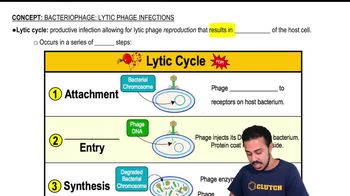
A lytic infection occurs when a virus enters a host cell, replicates rapidly, and causes the cell to burst (lyse), releasing many new viruses quickly. This process leads to cell death and a sudden release of viral particles.
Recommended video:
Guided course
04:58
Bacteriophage: Lytic Phage Infections

Persistent Infection

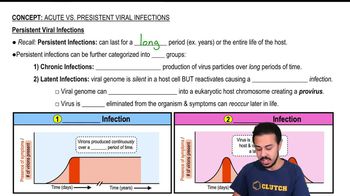
A persistent infection is characterized by the continuous production and release of viruses from the host cell over an extended period without causing immediate cell death. The virus replicates slowly, allowing the host cell to survive while shedding viruses.
Recommended video:
Guided course
05:12
Persistent Viral Infections

Enveloped Virus and Viral Shedding

Enveloped viruses have a lipid membrane surrounding their capsid, which they acquire from the host cell during budding. Viral shedding in enveloped viruses often occurs gradually as the virus buds off the host cell membrane, enabling slow and continuous release.
Recommended video:
Guided course
05:12
Persistent Viral Infections