Briefly describe the components of DNA, and explain its functional relationship to RNA and protein.
Ch. 8 - Microbial Genetics

Tortora14th EditionMicrobiology: An IntroductionISBN: 9780138200398Not the one you use?Change textbook
Chapter 8, Problem 2
Transfer of DNA from a donor to a recipient as naked DNA in solution.
a. Conjugation
b. Transcription
c. Transduction
d. Transformation
e. Translation
Verified step by step guidance1
Read the problem carefully to understand that it asks for matching a term to the definition: 'Transfer of DNA from a donor to a recipient as naked DNA in solution.'
Recall the definitions of the given terms: conjugation, transcription, transduction, transformation, and translation.
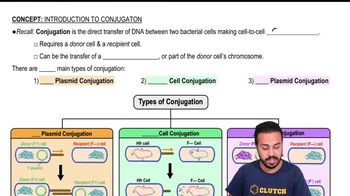
Identify that 'conjugation' involves direct cell-to-cell contact for DNA transfer, so it does not match the definition.
Recognize that 'transcription' and 'translation' are processes related to gene expression, not DNA transfer between cells.
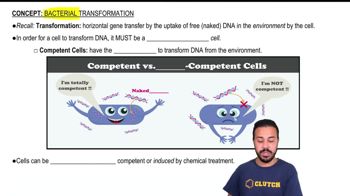
Understand that 'transformation' is the process where bacteria take up naked DNA from their environment, matching the definition given.

Verified video answer for a similar problem:
This video solution was recommended by our tutors as helpful for the problem above.
Video duration:
3mWas this helpful?
Key Concepts
Here are the essential concepts you must grasp in order to answer the question correctly.
Transformation
Transformation is the process by which bacteria take up free, naked DNA fragments from their environment and incorporate them into their own genome. This horizontal gene transfer method allows genetic variation without direct cell-to-cell contact.
Recommended video:
Guided course
Bacterial Transformation
Conjugation
Conjugation involves the direct transfer of DNA from a donor to a recipient bacterial cell through physical contact, usually via a pilus. It is a common mechanism for spreading plasmids and antibiotic resistance genes.
Recommended video:
Guided course
Introduction to Conjugation
Transduction
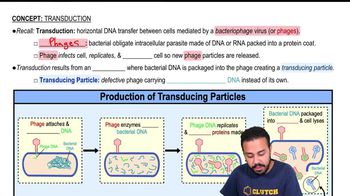
Transduction is the transfer of bacterial DNA from one cell to another mediated by bacteriophages (viruses that infect bacteria). It occurs when phages accidentally package host DNA and inject it into a new host.
Recommended video:
Guided course
Transduction
Related Practice
Textbook Question
1557
views
Textbook Question
Match the following examples of mutagens.
1602
views
Textbook Question
Feedback inhibition differs from repression because feedback inhibition
a. Is less precise.
b. Is slower acting.
c. Stops the action of preexisting enzymes.
d. Stops the synthesis of new enzymes.
e. All of the above
1003
views
Textbook Question
Identify and mark each of the following on the portion of DNA undergoing replication: replication fork, DNA polymerase, RNA primer, parent strands, leading strand, lagging strand, the direction of replication on each strand, and the 5′ end of each strand.
1482
views
Textbook Question
Transfer of DNA from a donor to a recipient cell by a bacteriophage.
a. Conjugation
b. Transcription
c. Transduction
d. Transformation
e. Translation
1422
views