Ch. 3 - Observing Microorganisms Through a Microscope
Tortora - Microbiology: An Introduction 14th Edition
Tortora14th EditionMicrobiology: An IntroductionISBN: 9780138200398Not the one you use?Change textbook
Chapter 3, Problem 6

Why is a mordant used in the Gram stain? In the flagella stain?

Verified step by step guidance
1
Understand that a mordant is a substance used in staining procedures to enhance the binding of the primary stain to the target structure, making it more visible under the microscope.
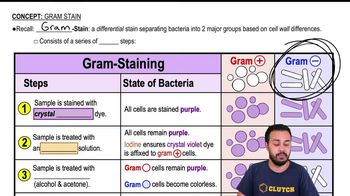
In the Gram stain, the mordant (usually iodine) forms a complex with the primary stain (crystal violet), creating a larger molecule that gets trapped within the thick peptidoglycan layer of Gram-positive bacterial cell walls.
This complex helps differentiate Gram-positive bacteria (which retain the crystal violet-iodine complex and appear purple) from Gram-negative bacteria (which do not retain it and are counterstained later).
In the flagella stain, the mordant is used to coat the thin flagella with a substance that increases their diameter, making them thick enough to be seen under a light microscope after staining.
Thus, in both stains, the mordant's role is to improve the visibility and differentiation of specific bacterial structures by enhancing stain retention or increasing structural size.

Verified video answer for a similar problem:

This video solution was recommended by our tutors as helpful for the problem above.
Video duration:
1m
Was this helpful?

Key Concepts

Here are the essential concepts you must grasp in order to answer the question correctly.

Gram Stain Procedure

The Gram stain is a differential staining technique used to classify bacteria into Gram-positive or Gram-negative based on their cell wall structure. It involves applying a primary stain, a mordant, a decolorizer, and a counterstain to distinguish bacterial types by color.
Recommended video:

Role of Mordant in Staining

A mordant is a chemical agent that binds to a dye and fixes it onto or into a specimen, enhancing the stain's intensity and retention. In the Gram stain, iodine acts as a mordant, forming a complex with crystal violet that gets trapped in thick peptidoglycan layers of Gram-positive bacteria.
Recommended video:

Flagella Stain and Mordant Use

Flagella are thin structures that are difficult to see under a microscope, so a mordant is used in flagella staining to coat and thicken the flagella, making them visible. The mordant binds to the stain and flagella, increasing their diameter for easier observation.
Recommended video:
Related Practice
Textbook Question

What is the purpose of a counterstain in the acid-fast stain?

1768
views

Textbook Question

Which of the following pairs is mismatched?

a. Capsule—negative stain

b. Cell arrangement—simple stain

c. Cell size—negative stain

d. Gram stain—bacterial identification

e. None of the above

1773
views
Textbook Question

The maximum magnification of a compound microscope is (a) ________; that of an electron microscope, (b) ________. The maximum resolution of a compound microscope is (c) ________; that of an electron microscope, (d) ________. One advantage of a scanning electron microscope over a transmission electron microscope is (e) ________.

1905
views
Textbook Question

Which of the following is not a functionally analogous pair of stains?

a. Nigrosin and malachite green

b. Crystal violet and carbolfuchsin

c. Safranin and methylene blue

d. Ethanol-acetone and acid-alcohol

e. All of the above pairs are functionally analogous.

1454
views
Textbook Question

Assume you stain Clostridium by applying a basic stain, carbolfuchsin, with heat, decolorizing with acid-alcohol, and counterstaining with an acidic stain, nigrosin. Through the microscope, the endospores are 1, and the cells are stained 2.

a. 1—red; 2—black

b. 1—black; 2—colorless

c. 1—colorless; 2—black

d. 1—red; 2—colorless

e. 1—black; 2—red

1649
views
Textbook Question

Calculate the total magnification of the nucleus of a cell being observed through a compound light microscope with a 10x ocular lens and an oil immersion lens.

1828
views