
Place the following in the order in which they are found in a host cell: (1) capsid proteins; (2) infective phage particles; (3) phage nucleic acid. a. 1, 2, 3 b. 3, 2, 1 c. 2, 1,3 d. 3, 1, 2 e. 1, 3, 2
Verified step by step guidance
1
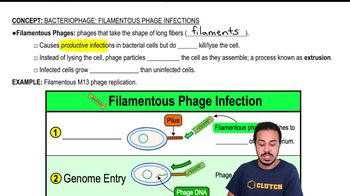
Understand the life cycle of a bacteriophage (phage) inside a host cell. When a phage infects a bacterial cell, it first injects its nucleic acid (DNA or RNA) into the host.
Recognize that after the phage nucleic acid is inside the host, it directs the host machinery to synthesize phage components, including capsid proteins.
Note that capsid proteins are produced after the nucleic acid is inside the host because the host's ribosomes translate the phage genes to make these proteins.
Once enough capsid proteins and nucleic acid are synthesized, they assemble inside the host cell to form complete infective phage particles.
Therefore, the correct order inside the host cell is: (3) phage nucleic acid, (1) capsid proteins, and finally (2) infective phage particles.
Verified video answer for a similar problem:
This video solution was recommended by our tutors as helpful for the problem above
Video duration:
1m
Play a video:
0 Comments
Key Concepts
Here are the essential concepts you must grasp in order to answer the question correctly.
Phage Nucleic Acid Entry
During infection, a bacteriophage injects its nucleic acid (DNA or RNA) into the host cell first. This genetic material carries the instructions for producing new viral components, initiating the replication cycle inside the host.
After the phage nucleic acid is inside the host, the host's machinery synthesizes capsid proteins based on viral genetic instructions. These proteins will later assemble to form the protective shell of new phage particles.
Once capsid proteins and nucleic acids are produced, they assemble into complete, infective phage particles inside the host cell. These mature virions are then ready to be released to infect new cells.