
Textbook Question
Reactions involved in the light-independent reactions of photosynthesis constitute the _______.
a. Citric acid cycle
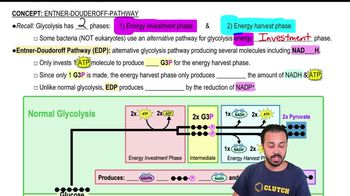
b. Entner-Doudoroff pathway
c. Calvin-Benson cycle
d. pentose phosphate pathway
1248
views

 Verified step by step guidance
 08:59
08:59
 05:58
05:58 02:29
02:29Reactions involved in the light-independent reactions of photosynthesis constitute the _______.
a. Citric acid cycle
b. Entner-Doudoroff pathway
c. Calvin-Benson cycle
d. pentose phosphate pathway
The glycolysis pathway is basically _______.
a. catabolic
b. amphibolic
c. anabolic
d. cyclical
Under ideal conditions, the fermentation of one glucose molecule by a bacterium allows a net gain of how many ATP molecules?
a. 2
b. 4
c. 38
d. 0
Under ideal conditions, the complete aerobic oxidation of one molecule of glucose by a bacterium allows a net gain of how many ATP molecules?
a. 2
b. 4
c. 38
d. 0
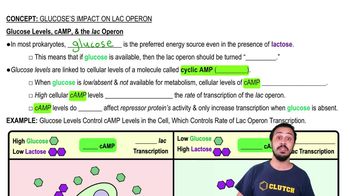
A laboratory scientist notices that a certain bacterium does not utilize lactose when glucose is available in its environment. Describe a cellular regulatory mechanism that would explain this observation.
A major difference between anaerobic respiration and anaerobic fermentation is _______.
a. in the use of oxygen
b. that the former requires breathing
c. that the latter uses organic molecules within the cell as final electron acceptors
d. that fermentation only produces alcohol