
Ch. 5 - Microbial Metabolism
Tortora - Microbiology: An Introduction 14th Edition
Tortora14th EditionMicrobiology: An IntroductionISBN: 9780138200398Not the one you use?Change textbook
Chapter 5, Problem 8

Write your own definition of the chemiosmotic mechanism of ATP generation. On Figure 5.16, mark the following using the appropriate letter:
a. The acidic side of the membrane
b. The side with a positive electrical charge
c. Potential energy
d. Kinetic energy

Verified step by step guidance
1
Begin by defining the chemiosmotic mechanism of ATP generation: it is the process by which ATP is synthesized using the energy stored in an electrochemical gradient of protons (H+) across a membrane, typically the inner mitochondrial membrane or the thylakoid membrane in chloroplasts.
Identify the acidic side of the membrane (a) by locating the side where protons (H+) accumulate, which results in a lower pH due to higher proton concentration.
Mark the side with a positive electrical charge (b) by recognizing that the accumulation of protons on one side of the membrane creates a positive charge relative to the other side.
Indicate potential energy (c) as the stored energy in the proton gradient across the membrane, which is the difference in proton concentration and electrical charge (proton motive force) that can be harnessed to do work.
Label kinetic energy (d) as the energy released when protons flow back across the membrane through ATP synthase, driving the mechanical rotation of the enzyme and catalyzing the formation of ATP from ADP and inorganic phosphate.

Verified video answer for a similar problem:

This video solution was recommended by our tutors as helpful for the problem above.
Video duration:
2m
Was this helpful?

Key Concepts

Here are the essential concepts you must grasp in order to answer the question correctly.

Chemiosmotic Mechanism of ATP Generation

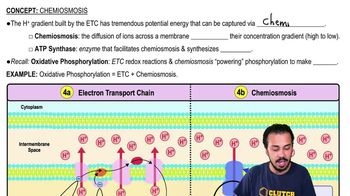
This mechanism explains how ATP is produced using the energy stored in a proton gradient across a membrane. Protons are pumped to one side, creating an electrochemical gradient, and their flow back drives ATP synthase to convert ADP and inorganic phosphate into ATP.
Recommended video:

Proton Gradient and Membrane Potential

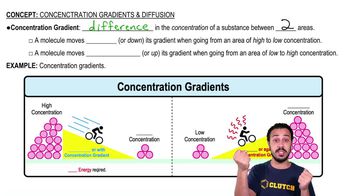
The proton gradient consists of a difference in proton concentration (pH) and electrical charge across the membrane. The acidic side has a higher proton concentration, creating a positive charge, which together form the proton motive force essential for ATP synthesis.
Recommended video:
Guided course
04:51
Concentration Gradients and Diffusion

Potential and Kinetic Energy in Chemiosmosis

Potential energy is stored in the proton gradient as a difference in concentration and charge across the membrane. Kinetic energy is the energy of protons moving back through ATP synthase, which drives the mechanical rotation needed for ATP production.
Recommended video: