Assume you are asked to view and draw all samples at a final magnification of 1000x. If the ocular lens is 10x, what objective lens should be in place as you draft your drawings?
Verified step by step guidance
1
Understand that the total magnification of a microscope is the product of the magnification of the ocular lens and the objective lens. This means: \(\text{Total Magnification} = \text{Ocular Magnification} \times \text{Objective Magnification}\).
Identify the given values: the total magnification desired is 1000x, and the ocular lens magnification is 10x.
Set up the equation using the known values: \(1000 = 10 \times \text{Objective Magnification}\).
Solve for the objective magnification by dividing both sides of the equation by 10: \(\text{Objective Magnification} = \frac{1000}{10}\).
Interpret the result to determine which objective lens (e.g., 40x, 100x) corresponds to the calculated magnification and select that lens for your drawings.
Verified video answer for a similar problem:
This video solution was recommended by our tutors as helpful for the problem above
Video duration:
1m
Play a video:
0 Comments
Key Concepts
Here are the essential concepts you must grasp in order to answer the question correctly.
Magnification in Microscopy
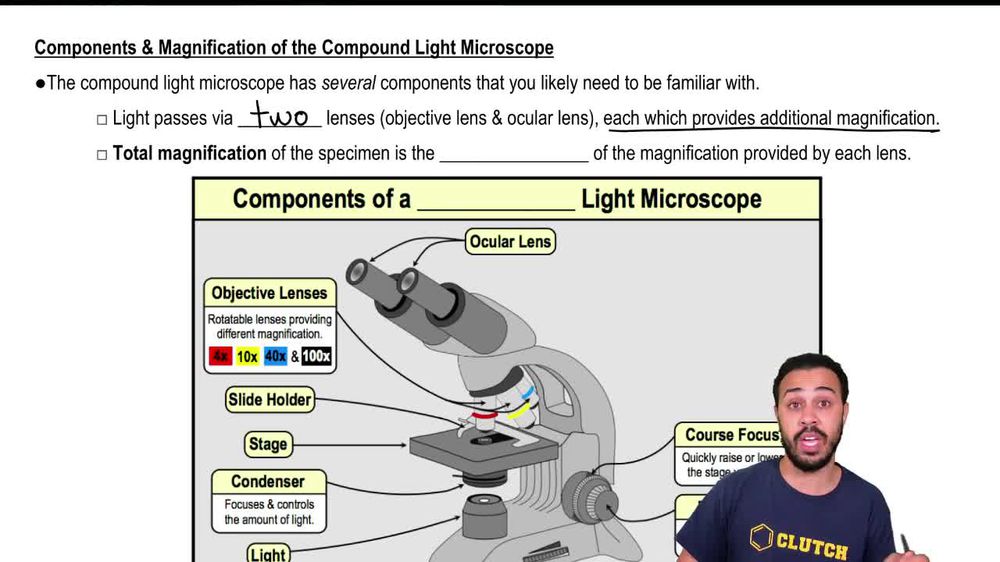
Magnification is the process of enlarging the appearance of an object using lenses. In light microscopy, total magnification is the product of the ocular lens magnification and the objective lens magnification. Understanding how these combine is essential to determine the correct lens needed for a desired final magnification.
Components & Magnification of the Compound Light Microscope
Ocular Lens (Eyepiece) Function
The ocular lens, or eyepiece, is the lens closest to the observer's eye and typically provides a fixed magnification, often 10x. It further enlarges the image formed by the objective lens, contributing to the total magnification seen through the microscope.
The objective lens is the primary lens responsible for initial magnification and resolution of the specimen. To achieve a specific total magnification, the objective lens magnification must be chosen so that when multiplied by the ocular lens magnification, it equals the desired final magnification.

 1:48 minutes
 Verified step by step guidance
 06:15
06:15