Ch. 3 - Introduction to Prokaryotic Cells
Norman-McKay- Microbiology: Basic and Clinical Principles 2nd Edition
Norman-McKay2nd EditionMicrobiology: Basic and Clinical PrinciplesISBN: 9780137661619Not the one you use?Change textbook
Chapter 3, Problem 16

Which of the following are true regarding osmosis? Select all that apply.
a. It is driven by differences in solute concentration.
b. It is the same as simple diffusion except it involves water.
c. It involves a selectively permeable membrane.
d. It requires energy to occur.
e. It requires specific channels.
f. Water moves from areas of high solute to areas of low solute.
g. Salt moves from high-water to low-water areas.
h. Water moves from areas of low solute to areas of high solute.

Verified step by step guidance
1
Step 1: Understand the definition of osmosis. Osmosis is the movement of water molecules across a selectively permeable membrane from an area of lower solute concentration to an area of higher solute concentration, aiming to equalize solute concentrations on both sides.
Step 2: Analyze option (a): Osmosis is driven by differences in solute concentration. Since water moves to balance solute concentrations, this statement is true.
Step 3: Analyze option (b): Osmosis is not the same as simple diffusion because it specifically involves water moving through a selectively permeable membrane, whereas simple diffusion refers to the movement of solutes from high to low concentration without necessarily involving water or membranes. So, this statement is false.
Step 4: Analyze option (c): Osmosis requires a selectively permeable membrane that allows water to pass but restricts solutes. This is a key characteristic of osmosis, so this statement is true.
Step 5: Analyze options (d) through (h) by applying the principles of osmosis: (d) Osmosis does not require energy (passive process), so false; (e) Water can move through membranes via aquaporins (specific channels), but osmosis can also occur directly through the lipid bilayer, so this is partially true but not always required; (f) Water moves from low solute to high solute, so false; (g) Salt does not move during osmosis, so false; (h) Water moves from low solute to high solute, so true.

Verified video answer for a similar problem:

This video solution was recommended by our tutors as helpful for the problem above.
Video duration:
2m
Was this helpful?

Key Concepts

Here are the essential concepts you must grasp in order to answer the question correctly.

Osmosis and Solute Concentration Gradient

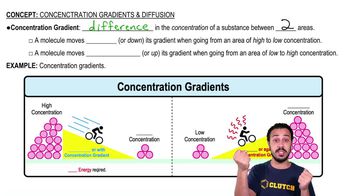
Osmosis is the movement of water across a selectively permeable membrane driven by differences in solute concentration. Water moves from an area of lower solute concentration (higher water concentration) to an area of higher solute concentration (lower water concentration) to balance solute levels on both sides.
Recommended video:
Guided course
04:51
Concentration Gradients and Diffusion

Selective Permeability of Membranes

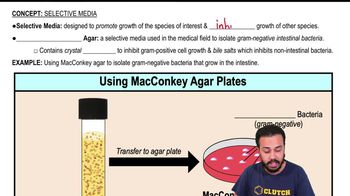
A selectively permeable membrane allows certain molecules, like water, to pass while blocking others, such as many solutes. This property is essential for osmosis, as it enables water to move to equalize solute concentrations without solutes freely crossing the membrane.
Recommended video:
Guided course
03:27
Selective Media

Passive Transport and Energy Requirement

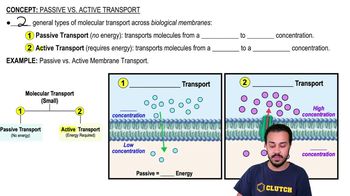
Osmosis is a passive transport process that does not require cellular energy (ATP). It relies on the natural kinetic movement of water molecules down their concentration gradient, distinguishing it from active transport mechanisms that need energy input.
Recommended video:
Guided course
04:18
Passive vs. Active Transport