Ch. 9 - Biotechnology & DNA Technology
Tortora - Microbiology: An Introduction 14th Edition
Tortora14th EditionMicrobiology: An IntroductionISBN: 9780138200398Not the one you use?Change textbook
Chapter 9, Problem 6

You have a small gene that you want replicated by PCR. You add fluorescent dye-labeled nucleotides to the PCR thermal cycler. After three replication cycles, what percentage of the DNA single strands will fluoresce?
a. 0%
b. 12.5%
c. 50%
d. 87.5%
e. 100%

Verified step by step guidance
1
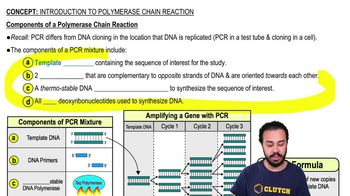
Understand that PCR (Polymerase Chain Reaction) doubles the amount of DNA each cycle by synthesizing new strands complementary to the original template strands.
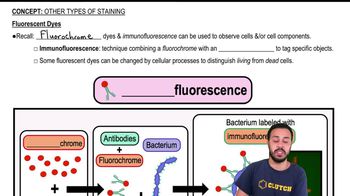
Recognize that fluorescent dye-labeled nucleotides are incorporated only into newly synthesized DNA strands during replication, not into the original template strands.
Calculate the total number of DNA strands after three cycles using the formula for exponential growth: \(\text{Number of strands} = 2^{n+1}\), where \(n\) is the number of cycles. Here, \(n=3\), so total strands = \$2^{4}$.
Determine how many of these strands are newly synthesized (and thus fluorescent). After each cycle, the number of new strands doubles, so after three cycles, the number of new strands is \(2^{3} = 8\).
Calculate the percentage of fluorescent strands by dividing the number of new strands by the total number of strands and multiplying by 100: \(\left( \frac{8}{16} \right) \times 100\).

Verified video answer for a similar problem:

This video solution was recommended by our tutors as helpful for the problem above.
Video duration:
2m
Was this helpful?

Key Concepts

Here are the essential concepts you must grasp in order to answer the question correctly.

Polymerase Chain Reaction (PCR) Amplification Cycles

PCR is a method to exponentially amplify DNA by repeated cycles of denaturation, annealing, and extension. Each cycle doubles the number of DNA strands, so after n cycles, there are 2^n DNA strands. Understanding how DNA quantity increases with cycles is essential to predict the amount of labeled DNA.
Recommended video:
Guided course
05:57
Components of a Polymerase Chain Reaction

Incorporation of Fluorescent Dye-Labeled Nucleotides

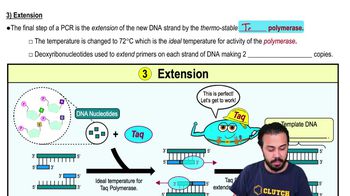
Fluorescent dye-labeled nucleotides are incorporated only into newly synthesized DNA strands during the extension phase. Original template strands remain unlabeled, while newly made strands contain the fluorescent label, allowing differentiation between original and replicated DNA.
Recommended video:
Guided course
02:59
Fluorescent Dyes

Calculation of Labeled DNA Proportion After Multiple PCR Cycles

After several PCR cycles, the proportion of labeled strands depends on how many strands are newly synthesized versus original. Since each cycle doubles the strands, the fraction of labeled strands can be calculated by comparing the number of labeled new strands to the total strands present.
Recommended video: