Ch. 18 - Immune Disorders
Bauman - Microbiology with Diseases by Taxonomy 6th Edition
Bauman6th EditionMicrobiology with Diseases by TaxonomyISBN: 9780134832302Not the one you use?Change textbook
Chapter 18, Problem 3

Why is a person who produces a large amount of IgE more likely to experience anaphylactic shock than a person who instead produces a large amount of IgG?

Verified step by step guidance
1
Understand the roles of different immunoglobulin classes: IgE and IgG are antibodies with distinct functions in the immune response. IgE is primarily involved in allergic reactions, while IgG is more involved in general immunity and pathogen neutralization.
Recognize that IgE binds to high-affinity receptors (FcεRI) on mast cells and basophils. When an allergen cross-links IgE molecules on these cells, it triggers degranulation, releasing histamine and other mediators that cause symptoms of allergy and anaphylaxis.
Contrast this with IgG, which typically neutralizes pathogens and facilitates phagocytosis without causing mast cell degranulation. IgG does not bind to the same receptors on mast cells and basophils, so it does not trigger the rapid release of inflammatory mediators.
Connect the high production of IgE to a greater likelihood of mast cell activation and systemic release of mediators, which can lead to widespread vasodilation, increased vascular permeability, and smooth muscle contraction characteristic of anaphylactic shock.
Summarize that a person producing large amounts of IgE is more prone to anaphylaxis because IgE-mediated mast cell degranulation causes the rapid and severe allergic response, whereas IgG production does not typically induce this pathway.

Verified video answer for a similar problem:

This video solution was recommended by our tutors as helpful for the problem above.
Video duration:
2m
Was this helpful?

Key Concepts

Here are the essential concepts you must grasp in order to answer the question correctly.

Immunoglobulin E (IgE) and Allergic Reactions

IgE is an antibody involved in allergic responses. It binds to allergens and triggers mast cells and basophils to release histamine and other mediators, causing symptoms like inflammation and bronchoconstriction. High IgE levels increase sensitivity to allergens, raising the risk of severe allergic reactions such as anaphylaxis.
Recommended video:
Guided course
05:48
Types of Chemical Reactions

Immunoglobulin G (IgG) and Immune Response

IgG is the most abundant antibody in blood and provides long-term immunity by neutralizing pathogens and facilitating their clearance. Unlike IgE, IgG does not typically trigger mast cell degranulation or histamine release, making it less likely to cause immediate hypersensitivity reactions like anaphylactic shock.
Recommended video:
Guided course
06:59
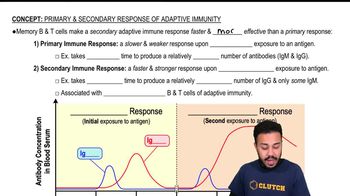
Primary and Secondary Response of Adaptive Immunity

Mechanism of Anaphylactic Shock

Anaphylactic shock is a rapid, systemic allergic reaction caused by massive release of histamine and other mediators from mast cells and basophils. This leads to vasodilation, airway constriction, and low blood pressure. IgE-mediated activation is central to this process, whereas IgG does not usually induce such severe systemic effects.
Recommended video:
Guided course
01:59
Introduction to Avoiding Host Defense Mechanisms