Spallanzani’s conclusion about spontaneous generation was challenged because Antoine Lavoisier had just shown that oxygen was the vital component of air. Which of the following statements is true? a. All life requires air. b. Only disease-causing organisms require air. c. Some microbes do not require air. d. Pasteur kept air out of his biogenesis experiments. e. Lavoisier was mistaken.
Verified step by step guidance
1
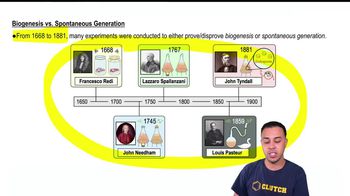
Step 1: Understand the historical context—Spallanzani's experiments aimed to disprove spontaneous generation by boiling broth and sealing flasks, but critics argued that sealing the flasks prevented air (and thus 'vital force') from entering, which was thought necessary for life to arise.
Step 2: Recognize Lavoisier's contribution—he identified oxygen as the essential component of air for sustaining life, which suggested that air was necessary for organisms to grow.
Step 3: Analyze the options in light of microbial diversity—some microbes, such as anaerobes, do not require oxygen to live, indicating that not all life requires air.
Step 4: Evaluate the experimental design of Pasteur—he allowed air to enter his flasks but prevented microbial contamination, showing that air alone does not generate life spontaneously.
Step 5: Conclude which statement aligns with modern microbiology—since some microbes do not require air, the correct understanding is that 'Some microbes do not require air.'
Verified video answer for a similar problem:
This video solution was recommended by our tutors as helpful for the problem above
Play a video:
0 Comments
Key Concepts
Here are the essential concepts you must grasp in order to answer the question correctly.
Spontaneous Generation and Biogenesis
Spontaneous generation is the outdated idea that life can arise from non-living matter. Spallanzani's experiments challenged this by showing that microorganisms did not grow in boiled broth sealed from air, supporting biogenesis—the principle that life arises from existing life.
Lavoisier identified oxygen as essential for many life forms, but not all microbes require oxygen. Aerobic organisms need oxygen to survive, while anaerobic microbes can live without it, which is crucial for understanding microbial diversity and growth conditions.
Experimental Design in Disproving Spontaneous Generation
Pasteur improved on Spallanzani’s work by allowing air but preventing microbial contamination using swan-neck flasks. This showed that air alone does not generate life, disproving spontaneous generation while acknowledging the presence of vital air components like oxygen.