Label and describe the function of each indicated part of the compound light microscope. <IMAGE>
Verified step by step guidance
1
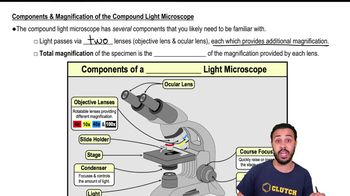
Identify each labeled part of the compound light microscope in the image. Common parts include the eyepiece (ocular lens), objective lenses, stage, diaphragm, light source, coarse and fine focus knobs, and arm.
Describe the function of the eyepiece (ocular lens), which is to magnify the image formed by the objective lens, usually providing 10x magnification.
Explain the objective lenses, which are the primary lenses that magnify the specimen. They usually come in different magnifications (e.g., 4x, 10x, 40x, 100x) and can be rotated into place.
Describe the stage, which is the flat platform where the slide is placed. It often has clips to hold the slide steady during observation.
Explain the diaphragm (or iris diaphragm), which controls the amount of light that reaches the specimen, helping to improve contrast and resolution.
Verified video answer for a similar problem:
This video solution was recommended by our tutors as helpful for the problem above
Video duration:
2m
Play a video:
0 Comments
Key Concepts
Here are the essential concepts you must grasp in order to answer the question correctly.
Parts of a Compound Light Microscope
A compound light microscope consists of several key parts including the eyepiece (ocular lens), objective lenses, stage, light source, diaphragm, and focus knobs. Each part plays a specific role in magnifying and viewing specimens clearly.
Components & Magnification of the Compound Light Microscope
Function of Objective and Ocular Lenses
The objective lenses, located near the specimen, provide primary magnification at different levels (e.g., 4x, 10x, 40x). The ocular lens further magnifies the image, usually by 10x, allowing detailed observation of microscopic structures.
The light source illuminates the specimen from below, while the diaphragm controls light intensity and contrast. Coarse and fine focus knobs adjust the distance between the objective lens and specimen to bring the image into sharp focus.